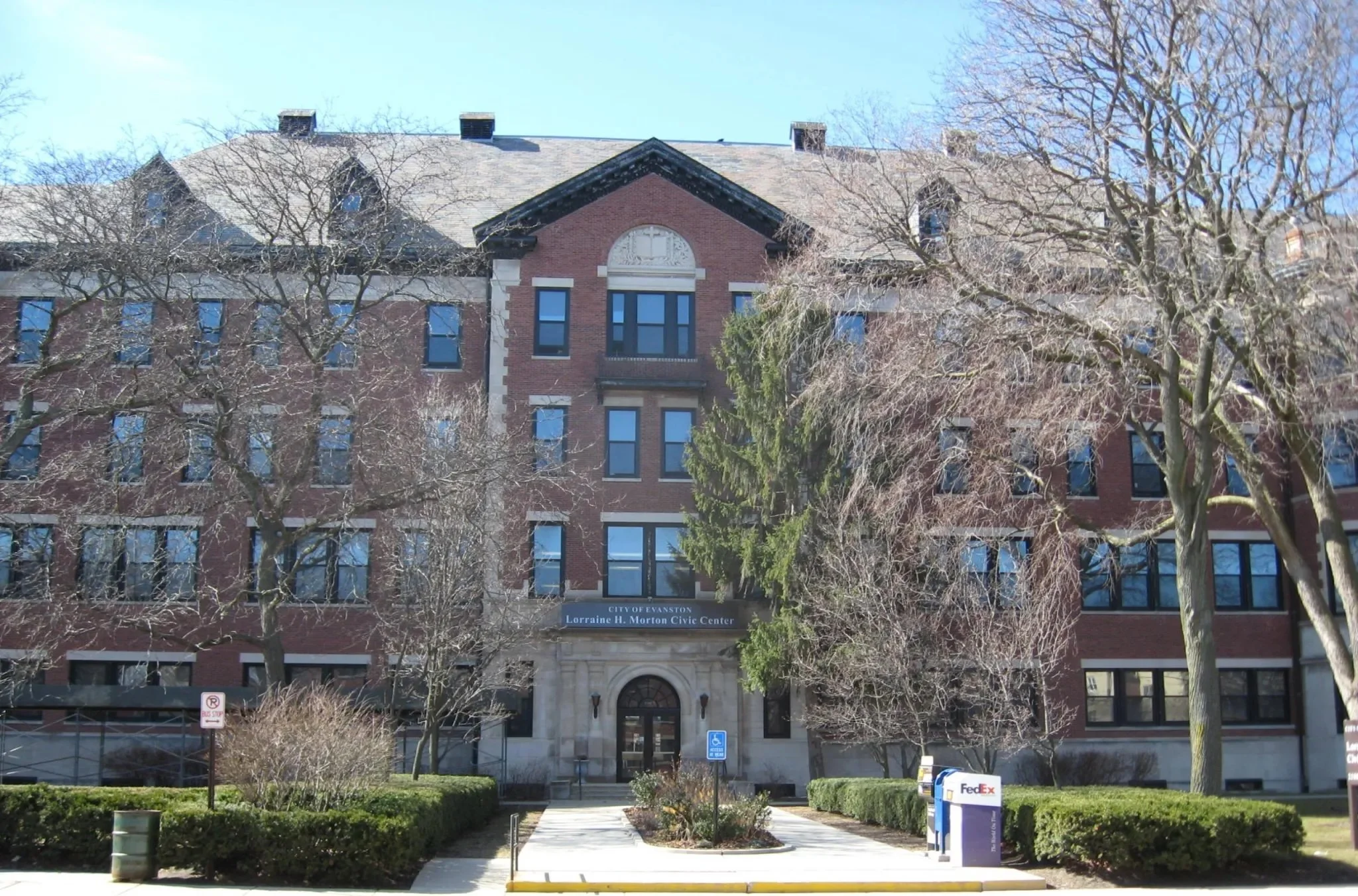
Historic former Marywood Academy and Evanston Civic Center at 2100 Ridge Avenue. Image Credit: Zol87, Wikimedia Commons, 2010. CC-BY-SA 2.0
Before Celadon publicly proposed affordable assisted living at the former Civic Center, records show the developer was already seeking City assistance to position the project for tax-credit financing.
Five weeks before Celadon Partners publicly submitted a low income assisted living proposal for the former Evanston Civic Center and historic Marywood Academy at 2100 Ridge Avenue through Evanston's Putting Assets to Work website, Celadon co-founder Scott Henry was already discussing the publicly-owned property with City staff and seeking City consent to pursue tax credits and certifications for an adaptive-reuse project.
The resulting emails show Preservation Planner Cade Sterling asking colleagues to prepare the requested consent letter on Celadon's behalf, Community Development Director Sarah Flax directing that it be prepared and later editing and advancing it for City Manager Luke Stowe's signature, and Stowe ultimately declining to sign because PAW remained underway and City Council had not yet provided direction.
Fifteen days later, Henry submitted Celadon's affordable assisted living concept through the PAW public-engagement portal.
The records also show City officials expressly discussing the boundaries of the process. In March, after Celadon lobbyist and former Chicago alderman Joe Moore asked whether “Scott Henry's group” could take a private assessment tour of the former Civic Center, Economic Development Manager Paul Zalmezak wrote internally that he wanted to “I'm just going to keep process clean. I don't think it'd be fair to give them a tour at this time.” One minute later, Stowe suggested a summer public open house that the group could attend instead.
A public open house was held on May 27, 2026. It has not been established why that occurred significantly earlier than the “...late summer? August?” date floated by Zalmezak given his statement that, “Putting assets to work process will be at recommendation phase in July.” Nevertheless, Evanston Action Coalition and Celadon Partners representatives were both in attendance.
The chronology adds previously undisclosed context to a process City officials had publicly described as genuinely open to housing or other uses.
What residents were told
The question first arose publicly in April, when Evanston resident and Evanston Action Coalition spokesperson John Storey Williamson asked City officials to reconcile the public presentation of PAW as an open-ended community process with language in Evanston's FY2024 federal PRO Housing application.
That application identified “Underutilized City Assets for Housing Development – Putting Assets to Work” and projected an impact of “TBD (initially up to 150 units of affordable housing).” It identified the associated barrier as “Limited Land for Affordable Housing Production.” (FY2024 PRO Housing Application, p. 7.)
Elsewhere, the application proposed expanding City capacity to “strategically develop publicly-owned land for affordable housing development” and specifically identified the soon-to-be-vacant Civic Center among the municipal assets being evaluated. (pp. 2, 8.)
In its proposed activities, the application classified “Putting Assets to Work Implementation (City-owned land)” under its strategy to fund housing-production programs and assigned the activity an anticipated impact of 150 units of affordable housing. (pp. 17–18.)
On April 20, Economic Development Manager Paul Zalmezak responded directly: “It is not a foregone conclusion that these properties will be redeveloped as housing.”
Zalmezak wrote that the PAW engagement process was “genuinely intended to help determine whether these sites should be used for housing or any other use, as well as how they might be developed.” He also said housing was “not predetermined.”
Zalmezak also said the City's inclusion of PAW in the PRO Housing application should not be read as converting the separate PAW initiative into a housing-only program. He explained that grant applications commonly identify other funding streams that can be “leveraged” toward the grant's objectives without changing the purpose or procedures attached to those other funds.
Even with that explanation, the FY2024 application did more than merely list PAW as an unrelated source of support. It placed PAW within the City's affordable-housing production strategy, identified underutilized municipal assets—including the Civic Center—as resources to help grow the affordable-housing supply, and assigned PAW an anticipated impact of up to 150 affordable units. (FY2024 PRO Housing Application, pp. 7–8, 17–18.)
The records produced in August provide a more detailed chronology of what was already occurring around 2100 Ridge while that public process was underway.
December 2025: financing discussions were already underway
On December 17, 2025, Scott Henry sent Preservation Planner Cade Sterling a document titled “Consent Letter for Applications.”
Henry described it as “the draft letter I mentioned to you a couple weeks ago,” indicating that the request had already been discussed before the first email now in the production. He wrote that the letter would consent to Celadon's applications for tax credits and certifications for the Civic Center.
Henry explicitly invoked the City's prior work with Celadon at Harley Clarke. He said the proposed letter was “virtually the same” as one the City had signed for Harley Clarke and asked that acceptable language be placed on City letterhead and returned signed.
At 8:33 the following morning, Sterling replied that he did not see any downside to the City and said similar letters could be furnished upon request to others interested in the properties.
Eleven minutes later, Sterling emailed City colleagues asking that they draft a tax-credit consent letter “on behalf of Celadon Construction Corporation” so the developer could begin preparing a tax-credit application related to adaptive use of the Civic Center.
Sterling explained that the letter would help Celadon meet tax-credit application deadlines that often do not align with municipal procurement and entitlement timelines. He also wrote that, if the City later pursued redevelopment and Celadon obtained the tax credits but was not selected through a competitive process, the incentives could be relinquished to the selected developer or moved to another qualifying Evanston property.
Three minutes later, Community Development Director Sarah Flax responded: “Please prepare the letter - thank you, Cade!”
By January 6, Flax had edited the letter herself. In an email to Sterling, copied to other staff, she wrote that she had updated the document and would get it to Stowe for signature. Later that day, Flax sent the proposed consent letter to Stowe and again told him she saw no downside to City participation.
January 6: Stowe declines to sign
City Manager Stowe did not sign the letter.
His response tied that decision directly to PAW and the absence of Council direction: “Celadon has been a great partner with Harley Clarke, but we have much more work to do on the PAW process, and the council has not yet provided direction, so I am not comfortable signing this document at this time.”
The email simultaneously documents the City's existing relationship with Celadon, the financing assistance Celadon was seeking for 2100 Ridge Avenue, and the procedural line the City Manager chose not to cross while PAW was still underway.
January 21: the concept appears in the public PAW process
Fifteen days after Stowe declined to sign the consent letter, Celadon’s Henry submitted a proposal through the PAW public-engagement process titled “4 Reasons to Pursue The Historic Adaptive Re-Use of the Civic Center into Affordable Assisted Living.”
By then, the proposal had a history outside the public portal. Approximately five weeks earlier, Henry had sought City consent to pursue tax credits and certifications for an adaptive-reuse project at the same property, and the City had spent several weeks preparing, editing and internally advancing the requested letter before Stowe declined to execute it.
The records produced by the City do not show what the PAW consulting team was told about those December-January financing discussions before Henry's January 21 submission. City staff were asked that question directly on August 18 and have not responded.
March 11: a private assessment tour is requested
On March 11, former Chicago alderman Joe Moore, president of Joe Moore Strategies, emailed Stowe and asked: “Can you please let me know if Scott Henry's group can take a quick assessment tour of the old Civic Center?” Public Illinois lobbying registrations identify Joe Moore Strategies as representing Celadon Partners.
The request was sent at 8:03 a.m.
At 8:48 a.m., Zalmezak wrote internally: “I'm just going to keep process clean. I don't think it'd be fair to give them a tour at this time.”
At 8:49 a.m., one minute later, Stowe replied: “Do we want to offer a public open house this summer, which they could attend if they wish?”
The emails document both the requested private access and the City's immediate decision to reject it on fairness grounds and consider a public-access alternative instead.
June: Celadon continues advancing the Civic Center concept
Celadon's interest in 2100 Ridge continued well beyond the January portal submission.
On June 19, Henry emailed senior City staff a video of Celadon's affordable assisted-living development in Deerfield. “This is the kind of use we are proposed [sic] for the Civic Center,” he wrote.
Four days later, in a lengthy email to Council Member Parielle Davis copied to Stowe, Flax and others about ongoing issues surrounding Celadon's Harley Clarke redevelopment, Henry identified the Civic Center as one of three possible paths forward.
“Celadon intends to pursue the redevelopment of the Civic Center into an affordable assisted living facility, which will be a competitive process,” Henry wrote.
He added that, if Celadon were selected, the company could incorporate Harley Clarke into the Civic Center project by using the Harley Clarke building as a community-service facility for Civic Center residents and for community activities.
By June, then, the record showed a continuous sequence: pre-portal financing discussions, a City-drafted consent letter, a City Manager refusal tied to PAW and Council direction, the public PAW submission, a request for private property access, continued direct promotion of the assisted-living concept to City staff, and an expressed intention by Celadon to pursue the Civic Center through a competitive process.
The Harley Clarke relationship
The Civic Center communications repeatedly invoked Celadon's existing relationship with the City through Harley Clarke.
In seeking the tax-credit consent letter, Henry cited the City's earlier Harley Clarke letter as the model. Sterling likewise relied on the Harley Clarke precedent when asking staff to prepare the Civic Center letter. And when Stowe declined to sign, he began by noting that Celadon had been “a great partner with Harley Clarke.”
The Harley Clarke relationship was not merely informal. Celadon had previously been selected through a City process for the adaptive reuse of the City-owned mansion, and an executed lease produced in FOIA 26-3521 provides for an initial 40-year term beginning March 1, 2025 at annual rent of $1, followed by successive five-year renewal periods unless terminated under the agreement.
That existing relationship gave the Civic Center discussions an established precedent: Celadon already knew the officials involved, had already worked with the City on historic-tax-credit issues, and could point to a prior City consent letter when seeking comparable assistance for 2100 Ridge.
The relationship between Celadon and the City extended beyond the Harley Clarke lease and the tax-credit precedent it created.
On March 23, 2026, the City Council unanimously approved Scott Henry's appointment to the Lighthouse Landing Complex Committee. City records state that Committee Chair and Council Member Parielle Davis had invited Henry to serve and that Mayor Daniel Biss recommended the appointment to the Council. The committee exists to facilitate coordination among organizations and groups with activities and responsibilities around the Lighthouse complex. Harley Clarke, which Celadon leases from the City, is adjacent to the Grosse Point Lighthouse and is part of the Lighthouse Landing area.
Celadon's role at Harley Clarke therefore provided an evident reason for Henry's participation on the committee. The timing nevertheless added another formal City relationship while Celadon was pursuing the Civic Center. The appointment came on March 23—twelve days after Celadon lobbyist Joe Moore asked City Manager Luke Stowe whether “Scott Henry's group” could take a private assessment tour of the former Civic Center, a request City officials declined on fairness grounds.
The relationship also had a political dimension. Campaign-finance records show that Scott Henry and his wife, Tanya Henry, contributed a combined $28,000 to Daniel Biss's campaign committees in 2025. Federal filings attribute $7,000 in election-cycle contributions to each of them to Biss for Congress. Separately, Friends of Daniel Biss reported receiving $7,000 from Scott Henry and $7,000 from Tanya Henry on November 1, 2025.
Those contributions preceded the Civic Center communications documented in the City's FOIA production. On December 17, approximately six weeks after the $14,000 contribution to Friends of Daniel Biss, Scott Henry sent City staff the proposed Civic Center consent letter and sought City assistance in positioning Celadon's project for tax-credit financing.
Neither the campaign contributions nor Henry's committee appointment establishes that Biss, Davis or any other City official gave Celadon favorable treatment. They do, however, provide additional context for the extent of Celadon's relationships with City officials while the developer was simultaneously pursuing another major City-owned property.
City staff were asked to explain the sequence.
Questions about PAW's relationship to the PRO Housing application were raised with City staff beginning in April.
Community Development Director Sarah Flax wrote that she was “happy to talk” and asked Storey Williamson to provide possible meeting dates. He did so on April 21, but a meeting with Flax was not scheduled.
Storey Williamson renewed the request in May. PAW consultants Ryan Porter and Michael McLean expressed willingness to meet, while McLean noted that many of the questions concerning PRO Housing and City policy fell outside the consultants' scope. Council Member Clare Kelly also asked to participate.
Storey Williamson subsequently met with consultant MPact’s Ryan Porter on multiple occasions, individually and as part of a group of Evanston Action Coalition members. Those discussions have largely concerned Evanston Action Coalition's Complete Civic Campus proposal for 2100 Ridge rather than the separate questions directed to City staff about the PRO Housing application and, following the August FOIA production, the City's earlier interactions with Celadon.
After FOIA 26-3521 produced the December, January, March and June records, Storey Williamson wrote directly to Stowe, Flax and Zalmezak on August 18 with eleven specific questions. Among them: when staff first learned of Celadon's Civic Center plans; what assistance staff provided; whether the PAW consultants knew of the earlier financing discussions; whether other prospective developers were affirmatively informed that comparable assistance was available; what occurred around the request for private property access; and what safeguards were being used to prevent an existing City relationship from creating an informational, financing, timing or access advantage in a future disposition process.
As of August 28th, Luke Stowe, Sarah Flax, and Paul Zalmezak have not responded to request for comment.
What the obtained records show
The public chronology is now clear.
In December, Celadon was already seeking City consent to begin positioning financing for a Civic Center adaptive-reuse project. City staff prepared and revised the requested document. On January 6, Stowe declined to sign because PAW remained underway and Council had not yet provided direction. On January 21, Henry submitted Celadon's affordable assisted living concept through the public PAW process. In March, Moore sought a private assessment tour for Henry's group; Zalmezak rejected the request as unfair and Stowe immediately suggested a public open house instead. In June, Henry continued promoting the assisted-living concept and stated that Celadon intended to pursue the Civic Center through a competitive process.
Those facts can be evaluated alongside the City's April representation that PAW was genuinely intended to determine whether the property should be used for housing or another use, as well as how it might be developed.
The unanswered issue is no longer whether Celadon had a Civic Center concept before its January 21 PAW submission. The City's own records establish that it did.
The remaining questions concern how far those predevelopment discussions went, what the PAW consultants knew about them, what comparable opportunities were communicated to other prospective developers, and how the City intends to manage the advantage of an existing developer relationship in any future competitive process.
About the FOIA request
FOIA Request 26-3521 was originally broader and was narrowed after the City estimated that the original request could encompass more than 69,055 pages. The final search covered specified City custodians, terms and records from December 1, 2025 through August 5, 2026. The City partially denied the request as to personal information and draft documents.
The production included the December-January consent-letter correspondence, the March 11 property-access exchange, the June communications and the executed Harley Clarke lease. The production did not include an executed Civic Center consent letter. City officials were asked on August 18 whether any version was ultimately signed and have not responded.
Resources
Aug. 17, 2026 — City of Evanston: FOIA Request 26-3521 Responsive Records
Responsive-records binder released by the City of Evanston containing emails and other records concerning Celadon, Scott Henry and the former Civic Center, including the December–January tax-credit consent-letter correspondence, the March 11 property-access exchange and June communications about Celadon’s Civic Center concept.
FY2024 — City of Evanston: PRO Housing Application Narrative
The City’s federal housing-grant application identifies Putting Assets to Work within its affordable-housing production strategy, discusses leveraging publicly owned land including the Civic Center, and assigns PAW an anticipated impact of up to 150 affordable units. The complete narrative is already in Drive.
May 27, 2026 — City of Evanston: Public Walkthroughs of the Former Civic Center
Official City notice announcing multiple guided walkthroughs of 2100 Ridge as part of the PAW process, the public-access alternative contemplated after City officials rejected a private assessment tour for Scott Henry’s group.
Mar. 23, 2026 — Evanston City Council: Scott Henry Appointment to Lighthouse Landing Complex Committee
Council records show Mayor Daniel Biss recommending Scott Henry’s appointment after Committee Chair and Council Member Parielle Davis invited him to serve. The appointment passed 9–0.
Related Coverage
Jul. 31, 2026 — Evanston Action Coalition: New Information Supports a Serious Renovation Analysis for 2100 Ridge
A contractor’s preliminary estimate supports treating rehabilitation of the former Civic Center as a serious option and comparing it transparently with demolition, replacement and private redevelopment.
Jul. 1, 2026 — Evanston Action Coalition: EAC Shares a Vision for a Civic Campus at 2100 Ridge
EAC’s public-use alternative for the property proposes retaining and modernizing Marywood Academy as part of a renewed Civic Campus with modern public-safety facilities and protected green space.
Feb. 26, 2026 — The Daily Northwestern: Residents Weigh Future of Three City Properties at Putting Assets to Work Meeting
Local coverage of the PAW community-engagement process and resident discussion about possible futures for the Civic Center, Police/Fire Headquarters and Noyes Cultural Arts Center.
Feb. 22, 2025 — Evanston Now: Council to Name ‘Assets’ Consultants
Early coverage of the consultant procurement for the federally funded PAW implementation process, including the firms and individuals selected to advise the City on the three properties.
Sept. 27, 2024 — Chicago Sun-Times: Evanston’s Landmark Harley Clarke Mansion Would Get Commercial Uses With Developer’s Plan
Background on Scott Henry and Celadon’s $29 million Harley Clarke proposal, including the developer’s financing strategy and historic-reuse experience before the City selected the proposal.
Oct. 15, 2024 — The Real Deal: Celadon Wins Bid to Develop Hotel at Historic Harley Clarke Mansion
Real estate industry coverage of Evanston’s selection of Celadon’s nonprofit subsidiary for the adaptive reuse of Harley Clarke, providing background on the City–Celadon relationship discussed in the FOIA records.