Part Four: What Council and the Public Were Told
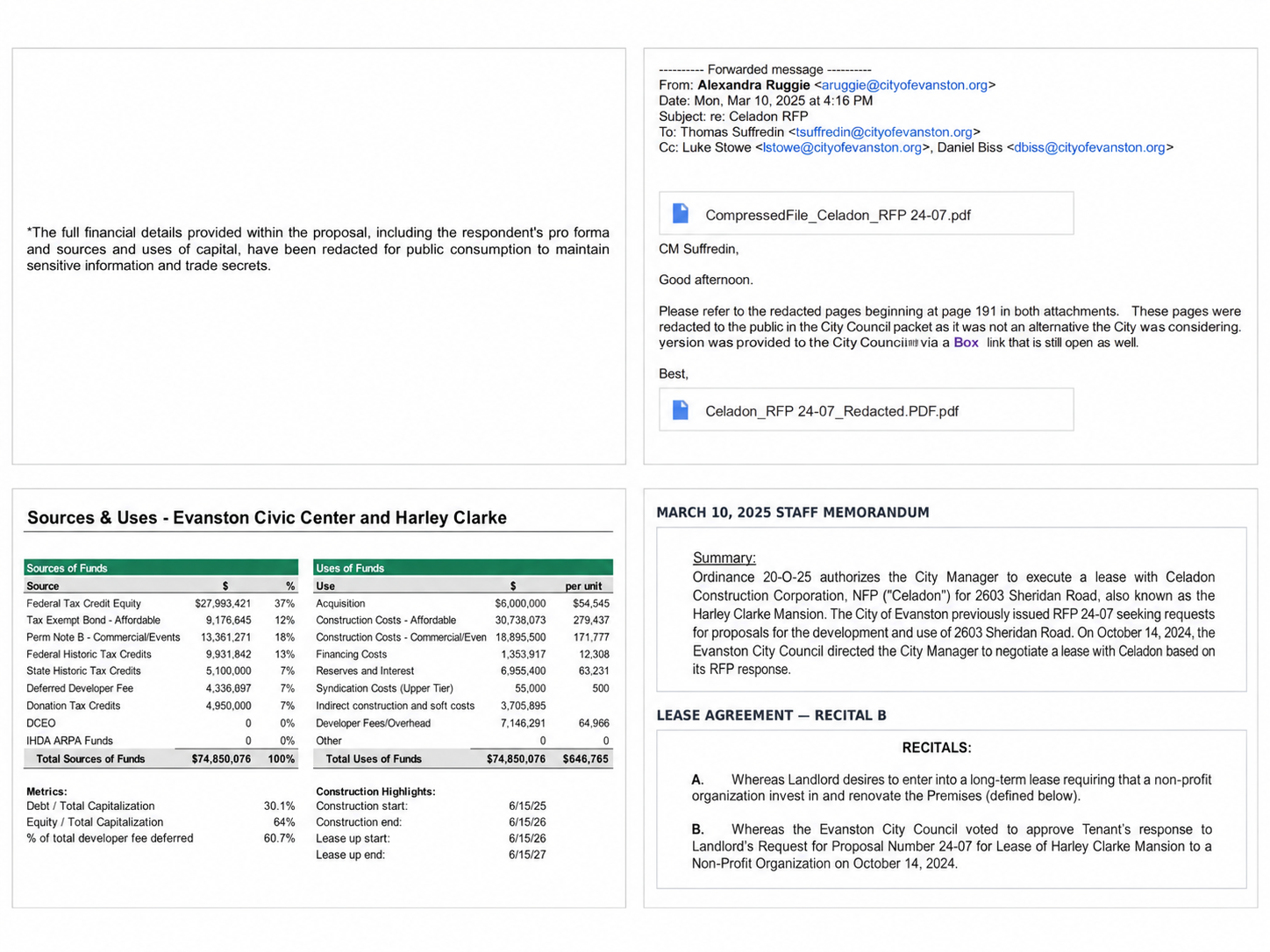
Key records cited in Part Four, including the public redaction notice, March 10 email, Celadon financial plan, and staff memo/lease language.
When Evanston selected Celadon to negotiate a long-term lease for Harley Clarke in October 2024, City staff presented the proposal as a projected $29.3 million private investment in rehabilitating the historic mansion as a boutique hotel and event venue. Celadon’s financing model, however, included $9,724,977 in equity generated through federal and Illinois historic tax credits—public subsidy mechanisms supporting approximately one-third of the modeled capital stack.
Parts One through Three of this series documented what the public version of Celadon’s response did not show. The same submission also contained a separately modeled alternative involving Harley Clarke and the Civic Center at 2100 Ridge Avenue: an approximately $74.85 million combined development, a modeled $6 million acquisition line for the combined transaction and 110 low-income apartments split between the two sites. That alternative relied even more heavily on tax-credit equity: $47,975,263 from federal Low-Income Housing Tax Credits, federal and Illinois historic tax credits and Illinois donation tax credits—approximately 64% of its proposed sources.
Part Four does not revisit how those pages were redacted or reconstruct the alternative again. It asks a narrower question: What were Council and the public told about Celadon’s response when Evanston selected the company, and how was the withheld material described once it surfaced publicly?
The proposal Council was asked to act on
On October 14, 2024, City staff asked the Evanston City Council to authorize the City Manager to negotiate a lease with Celadon Construction Corporation NFP for Harley Clarke.
The item was formally limited to 2603 Sheridan Road. Staff described a “projected $29,293,010 private investment” in the adaptive use and rehabilitation of the mansion and grounds. Celadon’s public-facing proposal called for a boutique hotel and event venue, restoration of the historic property and continued public access to much of the grounds.
Council was not being asked to sell or redevelop 2100 Ridge Avenue.
That distinction matters. Nothing in the record reviewed for this series establishes that the October vote authorized Celadon to redevelop the Civic Center. The disclosure issue is different: the response on which staff had evaluated Celadon contained substantially more than the public packet disclosed.
Staff gave Celadon’s proposal an average score of 99.1 and described its rehabilitation scope, schedule, financing plan and development team as creating a “compelling and predictable vision.” The recommendation emphasized Celadon’s financing, reserves, historic tax credits and outside commitments in making the case that its plan was unusually viable.
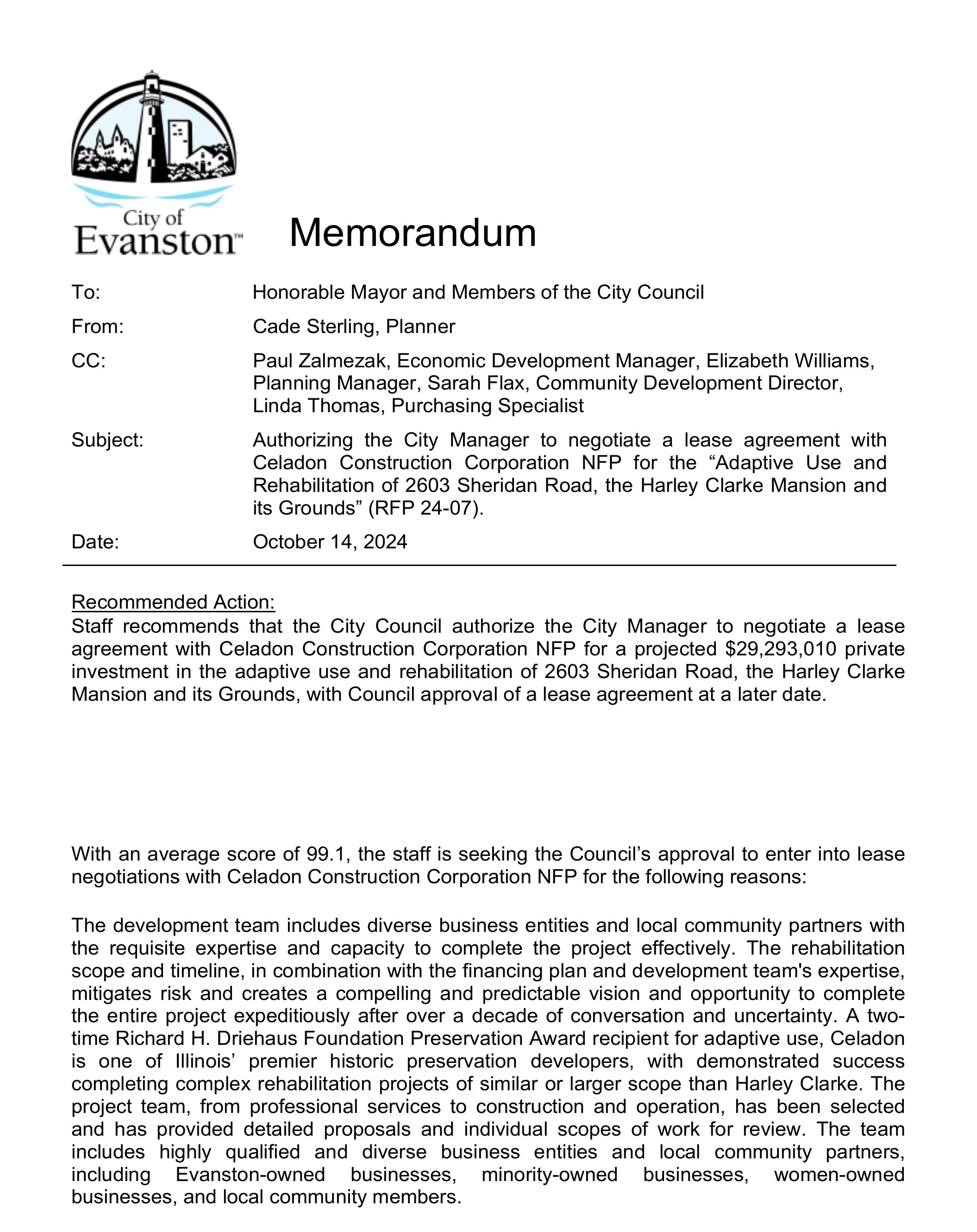
The packet acknowledged that information had been removed from Celadon’s response. The explanation was specific: “The full financial details” of the proposal, including the pro forma and sources and uses of capital, had been redacted from the public version to protect sensitive information and trade secrets.
That notice prepared a reader to expect hidden financial information. It did not tell the reader that entire removed pages also contained another development scenario involving a second major City property.

City of Evanston staff memorandum, October 14, 2024. Staff stated that Celadon’s full financial details—including its pro forma and sources and uses of capital—had been redacted from the version provided for public consumption, citing sensitive information and trade secrets. Source: October 14, 2024 City Council packet, SP3, p. 60.
A Harley Clarke story in public
The October Council discussion followed the same framing.
Celadon’s presentation and Council’s questions focused on the mansion: the hotel and event uses, public access, parking, gardens, tax revenue and provisions that would eventually need to appear in a lease.
Mayor Daniel Biss emphasized that Council was choosing a negotiating partner rather than approving every final term. Councilmember Eleanor Revelle similarly noted that negotiations would proceed from the proposal and that the resulting lease would return to Council.
The 110-unit housing alternative involving 2100 Ridge Avenue was not publicly examined.
Council voted 6-0 among the six members present to authorize negotiations with Celadon.
The public account that evening was therefore coherent: Evanston had selected a developer proposing to invest approximately $29.3 million to rehabilitate Harley Clarke.
As a description of Celadon’s primary proposal, that was accurate.
As a description of everything contained in Celadon’s response, it was incomplete.
What Council received is less clear
What individual Councilmembers knew before the October vote is more difficult to establish.
Corporation Counsel Alexandra Ruggie later said an unredacted version of Celadon’s response had been released to Council through a Box link in September or October and that staff had discussed the material with several Councilmembers who asked questions.
Councilmember Clare Kelly has said she had no access to the unredacted proposal and did not know about the combined Harley Clarke–Civic Center alternative.
Councilmember Jonathan Nieuwsma recalled being aware that Celadon had raised 2100 Ridge Avenue, but said the copy of the proposal he received was redacted like the public version.
Councilmember Thomas Suffredin said he believed Council had received a Box link, although he could not locate the email when asked about it.
Those accounts do not necessarily answer the same question. Distribution, access, review and knowledge are separate facts. Sending a link does not establish that a recipient opened it. Knowing that 2100 Ridge Avenue had been mentioned does not establish knowledge of the $74.85 million financial model. And staff discussing the material with some Councilmembers does not establish what every member received or understood before voting.
There is, however, contemporaneous evidence that, on Mar 10, 2025—the day of the final lease vote—at least one Councilmember was directed to the relevant portion of the proposal.
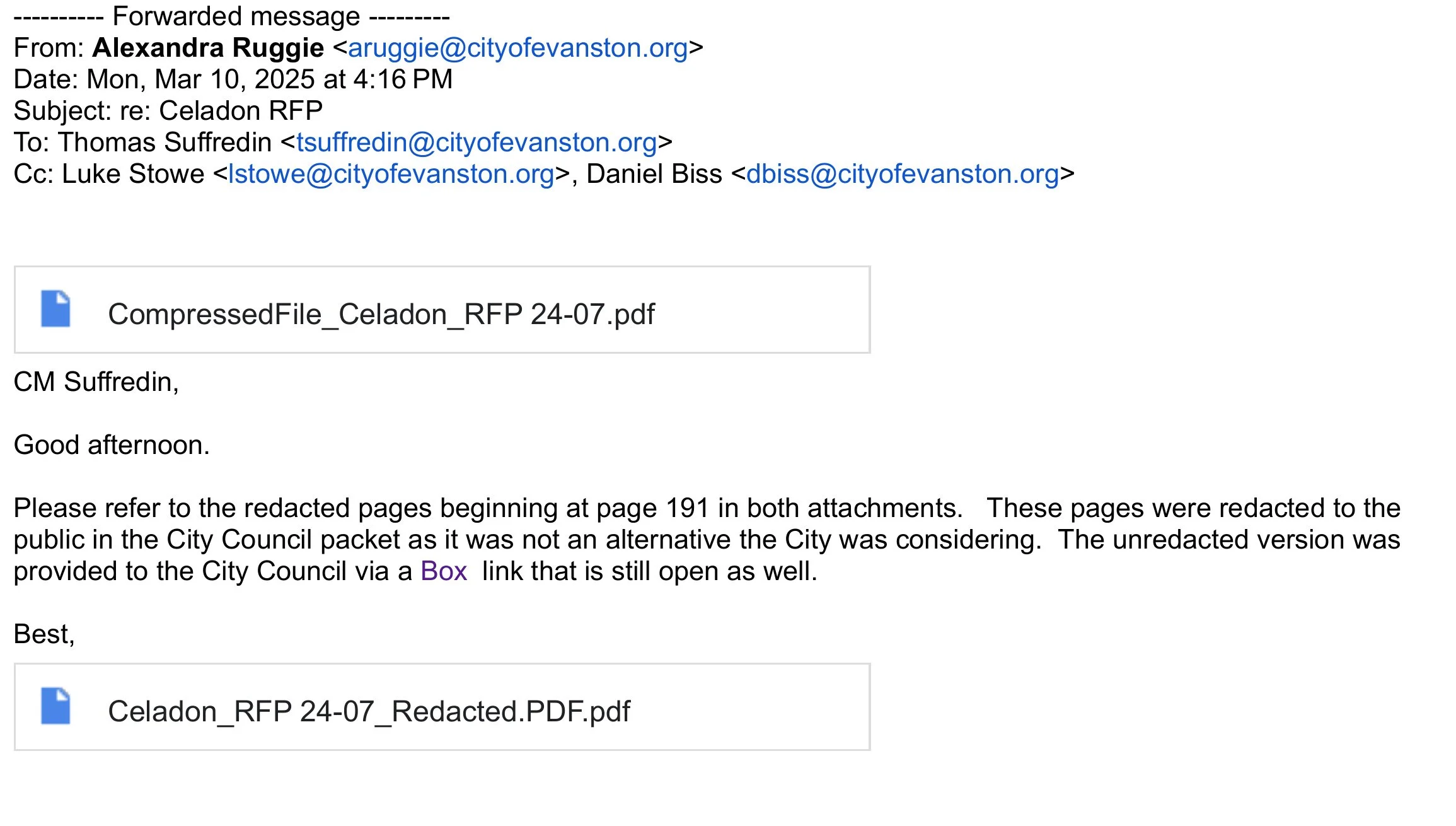
Email from Evanston Corporation Counsel Alexandra Ruggie to Councilmember Thomas Suffredin, March 10, 2025, 4:16 p.m. Ruggie directed Suffredin to redacted pages beginning at page 191 and wrote that the material had been withheld from the public City Council packet because it “was not an alternative the City was considering.” She also wrote that an unredacted version had been provided to City Council through a Box link. Source: correspondence provided to Evanston Action Coalition.
That record establishes a communication. It does not, by itself, establish what Suffredin reviewed, what he understood from it or what other Councilmembers received.
Five months later, the redactions became a public issue
The question returned on March 10, 2025, when Council was considering both the future of the Civic Center and the final Harley Clarke lease.
During public comment, resident Meg Welch challenged the extensive redactions in the version of Celadon’s proposal released publicly. Welch said pages outside what appeared to be the financial material had been blacked out and urged Council to determine what had been withheld before taking related action. She also raised a potential Open Meetings Act issue. That was Welch’s allegation, not a legal finding.
Later in the meeting, during the Civic Center discussion, Kelly asked what had been removed “page after page after page” from the Celadon materials and whether any of it related to the Civic Center.
Ruggie acknowledged that the redacted material contained an alternative submitted with Celadon’s RFP response.
Her description of that alternative was narrower than the document now available.
Ruggie said Celadon had expressed interest in the ability to apply or submit a proposal involving the Civic Center if that opportunity “came to fruition.” She said the material had been removed because it was not an alternative the City was considering and was not what Council had voted on. She also said the unredacted material had previously been released to Council and discussed with several members.
One part of that explanation is supported by the public record: the October authorization concerned lease negotiations for Harley Clarke. Council had not voted to dispose of the Civic Center.
The characterization of what Celadon had submitted is a separate question.
The recovered C-2 material was not simply an expression of possible future interest in applying for the Civic Center. It already contained a modeled combined transaction with an estimated development cost of approximately $74.85 million, a $6 million acquisition assumption for 2100 Ridge Avenue, 110 apartments, a unit-and-rent schedule, combined sources and uses, a development timetable and project-specific work attributed to AECOM and National Equity Fund.
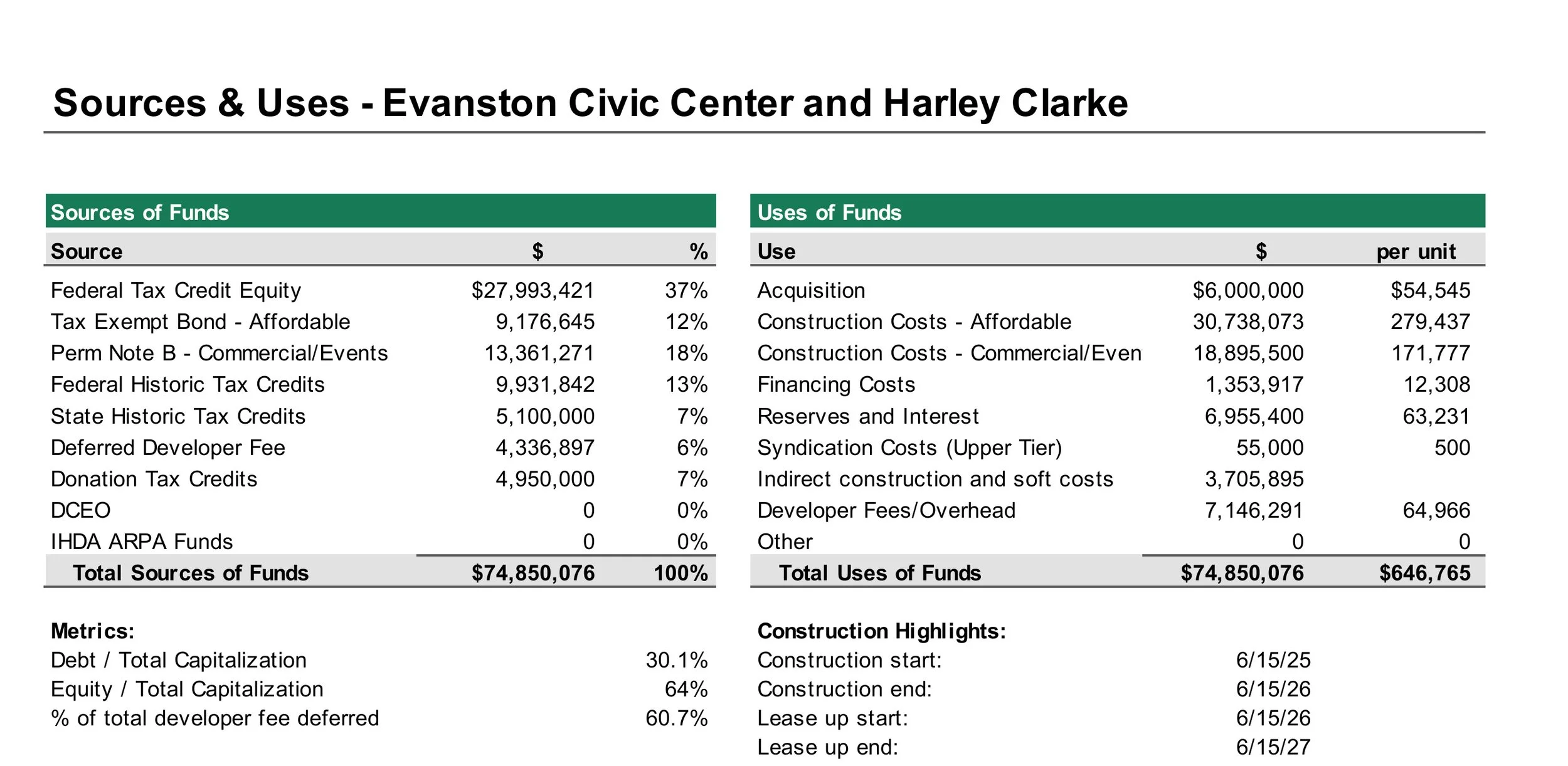
Celadon financial materials submitted with its response to Evanston RFP 24-07. The “Sources & Uses — Evanston Civic Center and Harley Clarke” page outlined a $74.85 million development plan, including a $6 million acquisition cost and $27.99 million in federal tax-credit equity, along with federal and state historic tax credits. The City’s publicly posted Celadon proposal identifies a separate “Sources and Uses” financial-model attachment among the submission materials. Source: Celadon RFP 24-07 financial materials.
Saying the alternative was not under consideration may explain why staff did not recommend it to Council.
It does not answer a different question: why the public version did not disclose the existence and scope of the alternative rather than simply identifying it and explaining that the City had rejected it as outside the matter being considered.
What the final lease said
The wording of the final Harley Clarke lease introduced another wrinkle.
The March staff memorandum said Council had directed the City Manager in October to negotiate a lease “based on” Celadon’s RFP response.
The lease itself stated in a recital that Council had “voted to approve Tenant’s response” to RFP 24-07.
Legally, the lease remained confined to Harley Clarke. Its permitted uses involved the hotel, event venue, restaurant, retail and related operations. It did not authorize housing or redevelopment at 2100 Ridge Avenue.
Still, the wording is notable because Celadon’s “response” contained both the Harley Clarke plan that had been publicly presented and the C-2 alternative that had not.
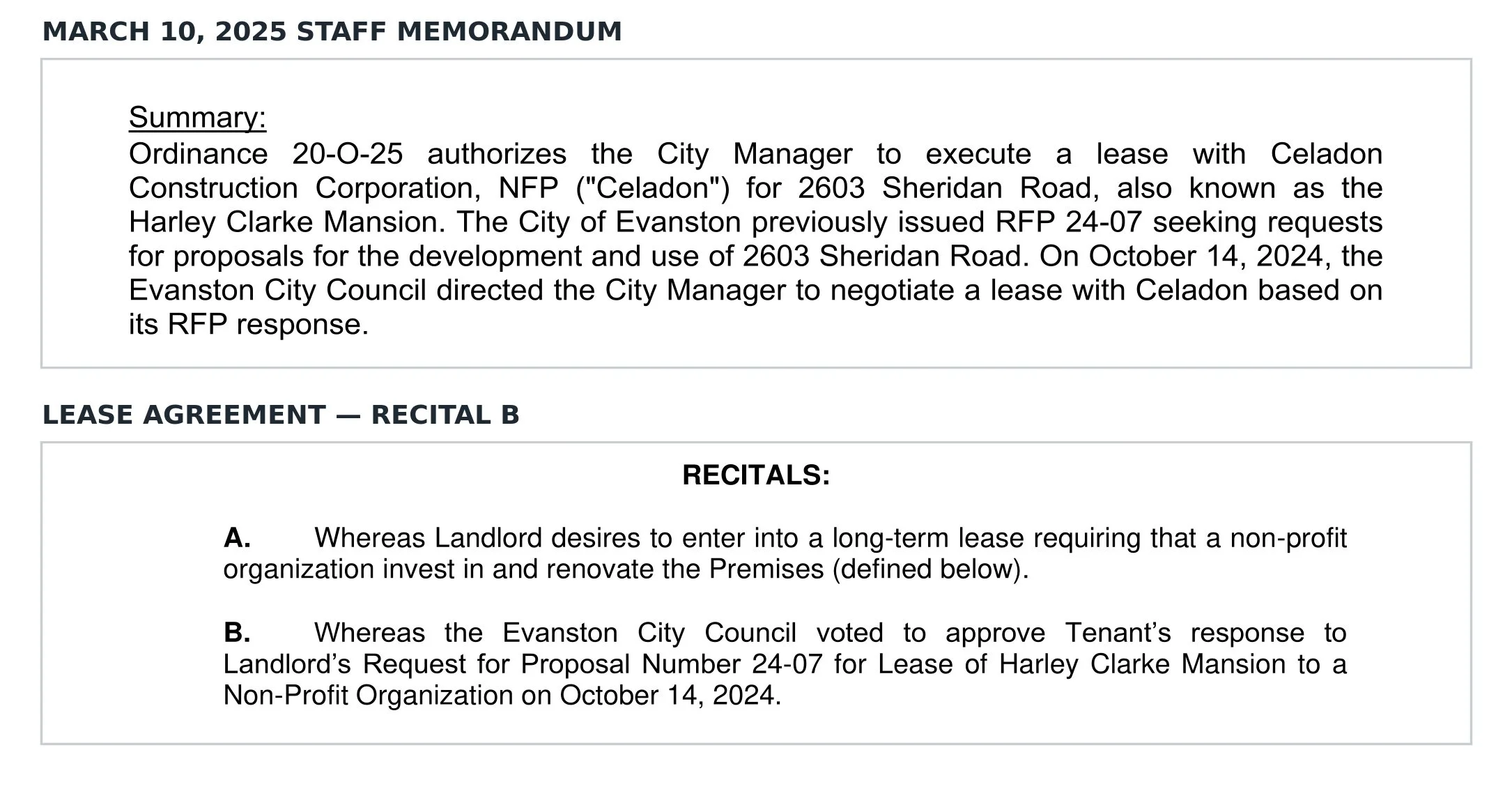
Side-by-side comparison of the March 10, 2025 City staff memorandum and the Celadon lease agreement. The staff memorandum stated that City Council directed the City Manager to negotiate a lease with Celadon “based on its RFP response.” Recital B of the lease states that Council “voted to approve Tenant’s response” to RFP 24-07 on October 14, 2024. Sources: City of Evanston March 10, 2025 staff memorandum and Celadon lease agreement for 2603 Sheridan Road.
Council approved the final lease 7-1, with Kelly voting no and Councilmember Bobby Burns absent.
The combined Harley Clarke–Civic Center alternative was not substantively examined during deliberation on the lease.
What the record establishes—and what it does not
The documentary record does not establish that Council secretly approved redevelopment of 2100 Ridge Avenue in October 2024.
It does not establish that every Councilmember had the same information about C-2 before voting.
And it does not establish that Evanston was required to consider or accept Celadon’s alternative.
What it does establish is narrower.
Residents evaluating the City’s recommendation received a detailed account of Celadon’s primary proposal, while the nature and substance of a second developed alternative—one involving the Civic Center—were absent from the public copy.
When the redacted pages became a public issue five months later, the alternative was described principally as Celadon’s interest in being able to pursue a Civic Center proposal if an opportunity later arose. The recovered documents show that Celadon had already gone considerably further: it had developed a financial and construction model for a combined transaction involving both properties.
Whether that alternative influenced staff’s evaluation of Celadon, whether it should have been expressly rejected as outside the Harley Clarke RFP and precisely which Councilmembers reviewed it before the October vote remain separate questions.
Precisely what individual Councilmembers knew remains disputed. What residents were given to evaluate is clearer: the public version did not disclose that C-2 was a developed, financially modeled alternative pairing Harley Clarke with the Civic Center.
Part Five will examine what was already occurring around the Civic Center and 2100 Ridge Avenue while the Harley Clarke process was moving forward.
Related coverage
Sep 27, 2024 — Chicago Sun-Times: Developer’s plan would usher commercial uses into Evanston’s landmark Harley Clarke Mansion
Pre-Council coverage of Celadon’s publicly presented proposal, describing an approximately $29 million rehabilitation centered on weddings and other events, a boutique hotel, restaurant and retail uses. The article also reported that City staff had rated Celadon highest among the three bidders.
Oct 15, 2024 — The Daily Northwestern: City to negotiate a lease to rehabilitate Harley Clarke Mansion
Coverage of Council’s 6-0 authorization to begin lease negotiations with Celadon. The article described the proposal presented publicly as a roughly $29 million rehabilitation involving a 10-room hotel and wedding and event venue, while also reporting concerns about public access and the limited opportunity for public discussion before the vote.
Oct 17, 2024 — Evanston RoundTable: How Celadon won City Council vote for Harley Clarke lease
Follow-up coverage of Celadon’s selection and Council’s decision to enter lease negotiations, including the competing proposals, the staff evaluation and the public discussion surrounding the October vote.
Feb 26, 2025 — The Daily Northwestern: City Council delays decision on Harley Clarke Mansion
Coverage of Council’s decision to postpone final action on the proposed Celadon lease until March 10, with discussion focused on the lease terms, continued public access and the Lighthouse Beach fire pit.
Mar 11, 2025 — Evanston RoundTable: Council approves lease to create an event venue at Harley Clarke
Coverage of Council’s final approval of the long-term lease following the March 10 meeting, including the principal terms of the agreement and the public discussion surrounding the final action.
Resources
City Council — Oct 14, 2024 Harley Clarke Agenda and Staff Materials
The official materials recommending that Council authorize negotiations with Celadon for a projected $29,293,010 private investment at 2603 Sheridan Road. The packet includes the 99.1 average score, the “compelling and predictable vision” language and the notice describing the removed material as full financial details, including the pro forma and sources and uses of capital.
City of Evanston — Oct 14, 2024 City Council Minutes
The official minutes documenting the scope of the authorization, the 6-0 vote among the six Councilmembers present and the members recorded as absent.
City Council — Mar 10, 2025 Agenda and Staff Materials
The official meeting packet containing both the Civic Center item and Ordinance 20-O-25 authorizing the final Harley Clarke lease, including the staff memorandum and lease materials discussed in this article.
City of Evanston and Celadon Construction Corporation NFP — Executed Harley Clarke Lease
The final agreement for 2603 Sheridan Road. The lease defines the Harley Clarke premises and permitted uses and includes the recital stating that Council had “voted to approve Tenant’s response” to RFP 24-07.
City of Evanston FOIA 25-495 — Welch Celadon RFP Correspondence
Records concerning Margaret “Meg” Welch’s request for an unredacted proposal and the City’s handling of that request. The production includes Corporation Counsel Alexandra Ruggie’s Mar 10, 2025 email directing Councilmember Thomas Suffredin to the material beginning around page 191 and stating why those pages had been redacted from the public packet.
Evanston Action Coalition Video — Kelly Questions the Celadon Redactions and Council Access
Excerpt from the Mar 10, 2025 Council meeting in which Councilmember Clare Kelly asks what was removed from Celadon’s materials and Corporation Counsel Alexandra Ruggie describes the alternative, explains why it was not included in the public packet and says unredacted material had been provided to Council.
Evanston Action Coalition Video — Welch Challenges the Celadon Redactions
Excerpt from Margaret “Meg” Welch’s Mar 10, 2025 public comment challenging the scope of the redactions and urging Council to determine what had been withheld before acting.
Celadon Construction Corporation NFP — RFP 24-07 Response, Unredacted Version
Celadon’s May 28, 2024 submission. C-2, “Alternative Financing Plan and Development Scope,” appears at approximately pp. 191–199 and contains the combined Harley Clarke–Civic Center development model discussed in this article.
City of Evanston — Celadon RFP 24-07 Redacted Public Version
The version made available to the public during the selection process. It retains the C-2 heading while concealing substantive portions of the alternative and its supporting materials.