
Photo illustration: Evanston Action Coalition; Civic Center photo by Zol87/Wikimedia Commons, CC BY-SA 2.0; Harley Clarke photo by John Storey Williamson, all rights reserved, used with permission.
Once the concealed portions of Celadon’s proposal are restored, they reveal far more than the name of another City property. Behind the redactions was a detailed $74.85 million development model for Harley Clarke and the Civic Center — including 110 low-income apartments, a unit-and-rent schedule, an assumed acquisition cost, a construction timetable, continued event revenue and project-specific work from AECOM and National Equity Fund.
Part One established that Celadon’s May 28, 2024 Harley Clarke response contained two materially different development paths: the familiar approximately $29.3 million hotel-and-event redevelopment and a C-2 alternative combining Harley Clarke with the Civic Center at 2100 Ridge in a single affordable-housing transaction.
Part Two established that substantive portions of C-2 were withheld from the public record and that the redactions changed between copies, including three additional City-disclosed masks that removed Civic Center identifiers from the combined-project financial materials.
The next question is simpler: What was actually underneath the black boxes?
The answer was considerably more detailed than a few isolated financial figures. Once the concealed material is restored, it shows a developed two-property project with a defined housing program, a $74.85 million capital structure, an assumed $6 million acquisition cost, a construction and lease-up schedule, millions of dollars in projected annual event revenue and supporting analyses prepared by outside firms.
In other words, the withheld material did not merely show how Celadon proposed to finance an idea. It contained much of the substance necessary to understand what the idea actually was.
C-2 in brief
Part One established that C-2 was not simply another financing structure for the same Harley Clarke project. Celadon proposed combining Harley Clarke and the Civic Center under a single transaction as a low income housing development, with 100 apartments at 2100 Ridge and 10 studios inside Harley Clarke.
Celadon also said the alternative was only feasible if the two properties were paired. That context matters here because the materials behind the redactions did not merely finance the concept; they supplied much of its underlying development model.
The financial model treated the properties as one $74.85 million project
The concealed Sources & Uses was titled “Evanston Civic Center and Harley Clarke” and modeled the two properties together as a single $74,850,076 development. What had been unavailable to the public was not simply the project total, but the detailed allocation of costs, financing sources, tax-credit proceeds and developer compensation behind it.
On the uses side, Celadon included a $6 million acquisition line, approximately $30.74 million in affordable-housing construction costs, approximately $18.90 million in commercial and event construction costs, nearly $7 million in reserves and interest, approximately $3.71 million in indirect construction and soft costs and approximately $7.15 million in developer fees and overhead.
On the financing side, the model contemplated approximately $27.99 million in federal Low-Income Housing Tax Credit equity, approximately $9.18 million in tax-exempt affordable-housing debt, approximately $13.36 million in permanent commercial/event financing, approximately $9.93 million in federal historic-tax-credit equity, $5.1 million in Illinois historic-tax-credit equity, $4.95 million in donation-tax-credit equity and a deferred developer fee.
Nearly $48 million of the $74.85 million capital stack came from tax-credit equity: federal Low-Income Housing Tax Credits, federal and Illinois historic-tax-credit equity and Illinois donation-tax-credit equity. Those sources were not direct City appropriations, but they were public subsidy mechanisms — value generated through federal and state tax credits rather than ordinary project revenue or conventional debt.
The affordable-housing structure could also affect the local property-tax base. Illinois law directs assessors to value qualifying Section 42 properties with emphasis on the income approach and separately provides special-assessment reductions for eligible affordable rental housing. In practical terms, restricted rents and applicable affordable-housing assessment provisions can reduce the property’s taxable assessed value, reducing its share of local property-tax levies relative to an otherwise comparable unrestricted property.
Spread across the 110 apartments in C-2, the combined $74.85 million project represented approximately $680,000 in total development cost for each housing unit contemplated. That figure includes substantial nonresidential costs at Harley Clarke and should not be confused with apartment construction cost alone. Still, as a scale comparison rather than a like-for-like construction measure, MRED/RMLS Area Market Surveys generated September 8, 2026 show that the median price of all 836 residential properties sold in Evanston during the preceding 12 months was $452,500. The median among 500 attached-home sales was $331,750. Celadon’s combined-project cost therefore amounted to roughly 50% more than the median sale price of an Evanston home and slightly more than twice the median price of an attached home. Celadon separately attributed approximately $30.74 million to affordable-housing construction, an amount drawn from AECOM’s estimate for the 100-unit Civic Center conversion — approximately $307,000 per Civic Center apartment.
The same sheet also modeled construction beginning in June 2025, ending in June 2026, followed by lease-up through June 2027.
The $6 million acquisition line was Celadon’s assumption, not a City-approved price. However, the concept of acquisition did not appear from nowhere. In Celadon’s November 14, 2023 response to the City’s earlier Harley Clarke REI, it expressly proposed purchasing Harley Clarke for $2 million through a seller note and said ownership was necessary to access historic tax credits. Celadon even acknowledged that selling a publicly owned property to a private owner at a discount might not be the community’s preference.
By May 2024, Celadon’s primary RFP proposal had shifted to a long-term lease. C-2 then introduced a new $6 million acquisition line for the combined Harley Clarke–Civic Center transaction without allocating that amount between the two properties. That history makes the acquisition assumption more significant: Celadon had previously contemplated outright ownership of Harley Clarke before modeling an acquisition cost within the later two-property alternative.
The withheld pro forma defined the housing program
The combined-project pro forma adds another layer of specificity.
It modeled 110 apartments, all at 60% of Area Median Income.
The unit mix consisted of 10 studios, 40 one-bedroom apartments, 40 two-bedroom apartments and 20 three-bedroom apartments.
Celadon modeled gross monthly rents of $1,150 for the studios, $1,250 for one-bedroom units, $1,500 for two-bedroom units and $1,700 for three-bedroom units. After utility allowances, the pro forma rents were $1,070, $1,170, $1,400 and $1,580 respectively.
The model projected approximately $1.74 million in annual residential rent.
Read together with Celadon’s C-2 narrative, the documents also fit together in a revealing way: the narrative places 10 studio apartments inside Harley Clarke, while the combined pro forma contains exactly 10 studio units. The other 100 units — 40 one-bedroom, 40 two-bedroom and 20 three-bedroom apartments — correspond to the 100 apartments Celadon proposed at the Civic Center.
However, residents looking only at the redacted public record could not evaluate those assumptions because the substantive model was not available to them in this form.
The distinction matters. The information behind the redactions was not merely that Celadon was interested in “affordable housing.” It included what type of housing was being modeled, how many units were contemplated, what income level they would serve and what rents the developer assumed the project could support.
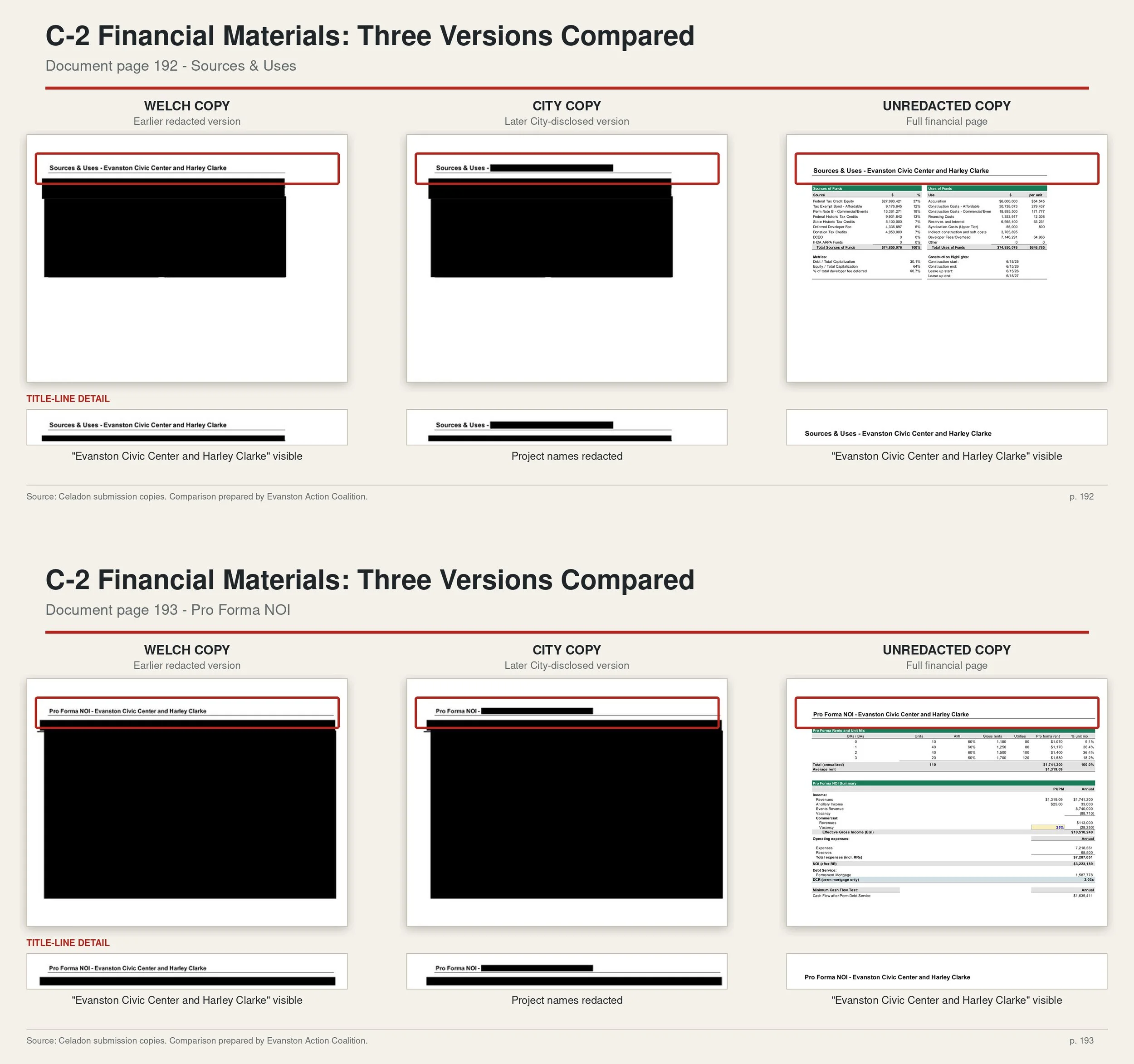
What was behind the redactions: Celadon’s combined financial model identified “Evanston Civic Center and Harley Clarke” as a single $74.85 million project and detailed the 110-unit housing program, rents, costs and financing sources.
The “less intensive” alternative still relied heavily on events
Under Celadon’s primary Harley Clarke plan, the operating pro forma projected $15.552 million in annual revenue from weddings, hotel operations, restaurant activity and other events.
The hotel component was not incidental. The primary pro forma attributed $2.352 million a year to hotel revenue — 15.1% of projected gross revenue, or about $1.764 million after the model’s 25% hotel-vacancy assumption. Yet, by May 2026 the City’s zoning review described event space, a restaurant, take-out ice cream and coffee, and retail, with no hotel. The September 2026 Preservation Commission materials now describe the mansion as being adapted for “a new restaurant use,” again without a hotel. Those materials are scheduled for consideration by the Preservation Commission on September 8. The public record reviewed to date does not identify what revenue source, if any, replaces the hotel revenue used in Celadon’s 2024 financial model.
The combined Civic Center–Harley Clarke pro forma still projected $8.74 million in annual events revenue.
By comparison, the 110 apartments were modeled to generate approximately $1.74 million in annual residential rent. The model also included $113,000 in commercial revenue, before a 25% commercial-vacancy assumption.
Altogether, Celadon projected approximately $10.51 million in effective gross income and approximately $3.22 million in net operating income after operating expenses and replacement reserves.
C-2 therefore reduced Celadon’s reliance on events without eliminating it. Even with 110 low-income apartments in the combined development, the pro forma projected five times as much annual revenue from events as from residential rents.
Celadon’s own numbers describe a mixed-use transaction: a substantial affordable-housing component paired with an event business at Harley Clarke that remained central to the project’s operating economics.
AECOM had priced a 100-unit Civic Center conversion
Celadon supported the C-2 financial model with a project-specific construction estimate from AECOM Hunt.
The estimate, dated May 22, 2024 — six days before Celadon submitted its response to the Harley Clarke RFP — identified the project location as “Evanston Civic Center, Evanston, IL.”
It modeled 100 residential units and detailed construction work associated with converting the Civic Center. Celadon used approximately $30.74 million from that estimate as the affordable-housing construction cost in its combined Sources & Uses model.
The residential-conversion estimate was distinct from the approximately $60 million AECOM estimate Celadon said had separately been prepared for Evanston to modernize the Civic Center for continued municipal use. The C-2 attachment instead priced a 100-unit residential conversion that Celadon incorporated into its alternative financing model.
The record does not identify who commissioned that residential-conversion estimate. What it does show is that project-specific AECOM work for 100 Civic Center apartments existed before Celadon formally submitted C-2 to Evanston.
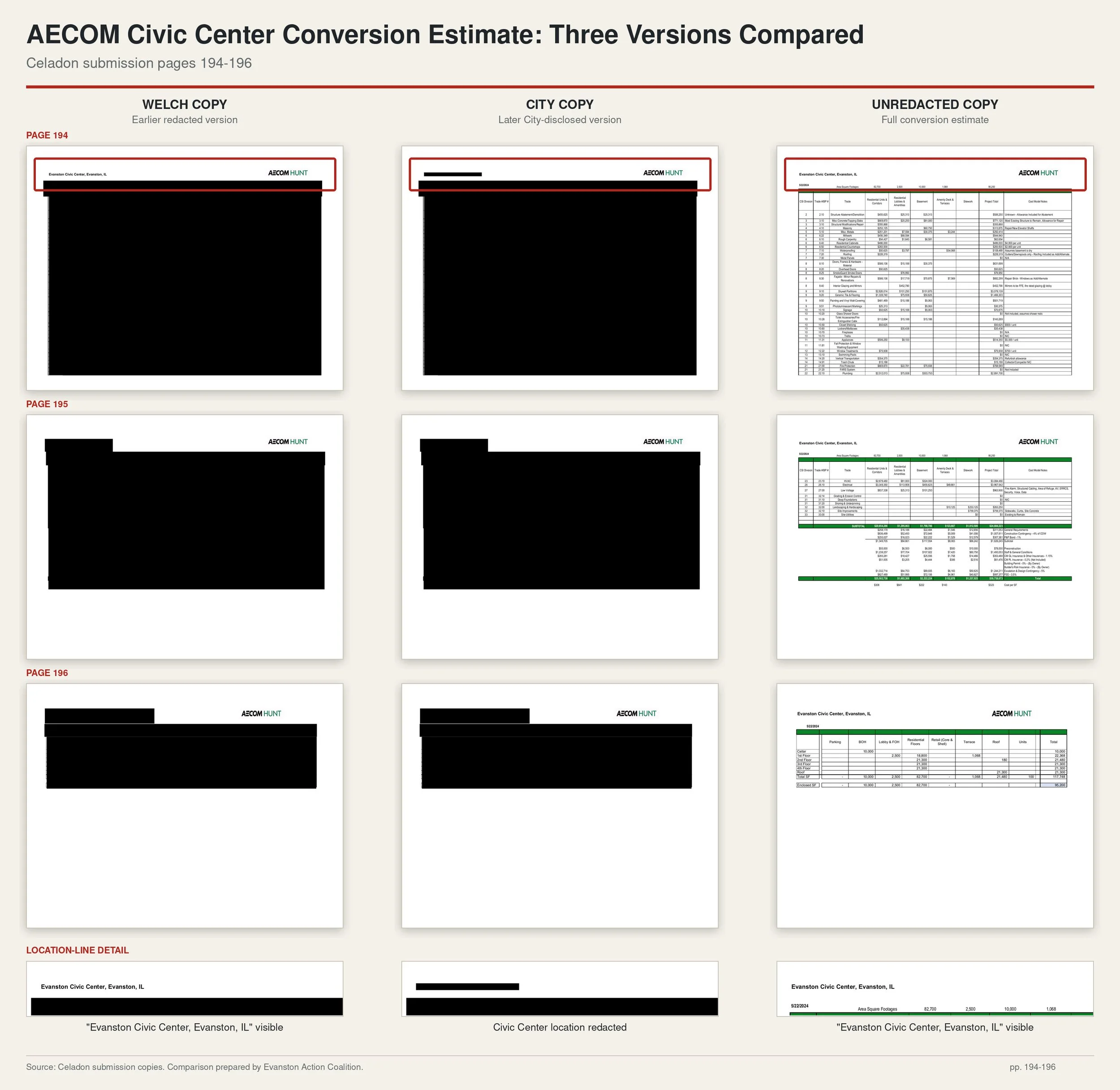
AECOM’s May 22, 2024 estimate identified the project location as “Evanston Civic Center, Evanston, IL” and priced a conversion involving 100 residential units.
National Equity Fund had already analyzed the combined project
The other major attachment was a May 15, 2024 letter from National Equity Fund Vice President Danny Gutman to Celadon’s Scott Henry concerning a project identified as “Evanston Civic Center and Harley Mansion” — a proposed 110-unit low-income housing development combining the two properties.
For purposes of understanding what was behind the redactions, the most significant language was NEF’s description of the information it had already received. Its analysis relied on assumptions concerning the project’s development budget, lease-up schedule, operating statements and ownership structure. The letter was preliminary, but it shows that an outside affordable-housing finance organization had already received enough project information to analyze those elements thirteen days before Celadon submitted its RFP response.
Who initiated that work, who supplied the underlying information and what Evanston officials knew are separate questions for later installments. The point here is narrower: that project-specific outside financing analysis was itself among the materials concealed from the public record.
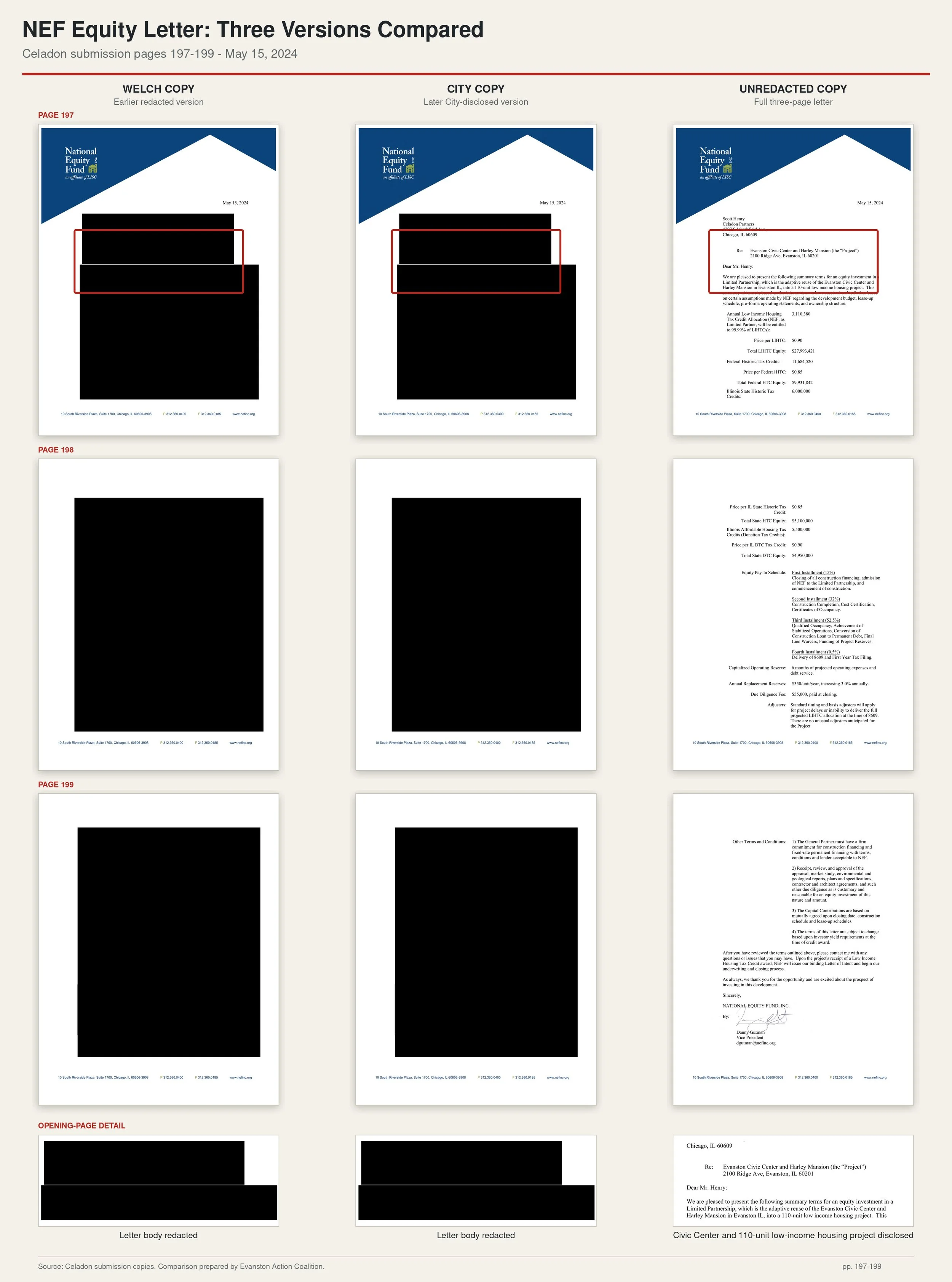
National Equity Fund was analyzing the combined “Evanston Civic Center and Harley Mansion” project before Celadon’s May 28 RFP submission, based on project budget, lease-up, operating and ownership assumptions already supplied.
What the documents do — and do not — establish
The records support several firm conclusions about Celadon’s own proposal.
They establish that Celadon submitted a detailed alternative pairing Harley Clarke with the Civic Center; that 2100 Ridge was necessary to the alternative as Celadon conceived it; that the proposal contained a defined 110-unit low-income housing program; that Celadon modeled the properties together as a $74.85 million transaction; and that AECOM and National Equity Fund had already performed project-specific work relevant to the combined development.
The documents do not show that Evanston approved C-2 or accepted the modeled $6 million acquisition assumption. They also do not answer who first suggested combining the properties or when City officials first learned of the concept. Those are separate questions.
None of that changes what the concealed materials contained: a developed two-property transaction with a defined housing program, acquisition assumption, financing structure, construction schedule and outside professional work — not a passing reference or undeveloped concept.
What comes next
Parts One through Three now establish three separate points: Celadon submitted a materially different Civic Center alternative; substantive portions of that alternative were withheld from the public record; and the concealed materials contained a detailed two-property development model rather than a passing reference or undeveloped concept.
The next question is what the people making the public decision were actually told. Part Four will examine what the City Council and the public were told when Celadon’s proposal came forward — and how that public account compares with the proposal we can now read.
Resources
Celadon Construction Corporation NFP — RFP 24-07 Response, Unredacted Version
Celadon’s May 28, 2024 submission. C-2, “Alternative Financing Plan and Development Scope,” appears at approximately pp. 191–199, including the combined Harley Clarke–Civic Center Sources & Uses, Pro Forma NOI, AECOM cost estimate and National Equity Fund analysis.
Margaret “Meg” Welch — Earlier Redacted Copy of Celadon RFP 24-07
The earlier 259-page redacted version obtained by Welch. Three Civic Center identifiers remained visible in this copy that were subsequently obscured in the later City-disclosed version.
City of Evanston — Celadon RFP 24-07 Redacted Public Version
The later City-disclosed version used in EAC’s page-by-page comparison. It contains three additional redactions on pp. 192–194, all affecting references identifying the Evanston Civic Center.
EAC Forensic Comparison — Celadon Financial Materials, pp. 190–195
Side-by-side comparison of the relevant financial pages showing the additional redactions affecting the Sources & Uses title, Pro Forma NOI title and AECOM Civic Center location. This is the principal comparison image used in the body of this article.
EAC Forensic Comparison — Redacted Pages in Welch Copy
Montage of the relevant redacted pages in the earlier copy obtained by Welch, providing broader context for the redaction pattern.
EAC Forensic Comparison — Redacted Pages in City Copy
Corresponding montage of the relevant pages in the later City-disclosed copy, providing the comparison point for the additional Civic Center-specific redactions.
Related Coverage
Sept. 27, 2024 — Chicago Sun-Times: Developer’s plan would usher commercial uses into Evanston’s landmark Harley Clarke Mansion
Pre-Council coverage of Celadon’s proposal, describing an approximately $29 million rehabilitation centered on weddings and other events, a boutique hotel, restaurant and retail uses. The story reported that City staff had rated Celadon highest among the competing proposals. The separate C-2 Civic Center alternative examined in this series was not part of the project described to readers.
Oct. 15, 2024 — The Daily Northwestern: City to negotiate a lease to rehabilitate Harley Clarke Mansion
Coverage following the City Council’s authorization to begin lease negotiations with Celadon. The article described the proposal presented publicly as a roughly $29 million rehabilitation of Harley Clarke involving a 10-room hotel and wedding and event venue, while also reporting concerns about public access and the limited opportunity for public discussion before the vote.
Oct. 17, 2024 — Patch: $29 Million Plan To Turn Harley Clarke Mansion Into Hotel, Bar, Restaurant Space Approved
Detailed coverage following the October 14 Council vote, describing the redevelopment as a boutique hotel, restaurant, bar and event venue. The article also reported Celadon’s projection of approximately 100 weddings annually and City staff’s estimate that the completed project could generate roughly $1 million per year in additional tax revenue.
Mar. 11, 2025 — Evanston RoundTable: Council approves lease to create an event venue at Harley Clarke
Coverage of the City Council’s final approval of the long-term Celadon lease following the March 10 meeting. The story provides contemporary context for the Harley Clarke redevelopment that ultimately moved forward and the public discussion surrounding the final agreement.
Aug. 30, 2026 — Evanston RoundTable: Here in Evanston: Building change
Coverage of the Putting Assets to Work proposals attracting public attention for Evanston’s major City-owned properties. The article identifies Celadon as a proponent of an affordable assisted-living redevelopment at the Civic Center and notes the developer’s existing role at Harley Clarke. It provides important present-day context for the records examined in this series: more than two years after Celadon submitted C-2 pairing Harley Clarke with 2100 Ridge, Celadon is again publicly pursuing a housing-related redevelopment of the Civic Center through a separate City process.
Sept. 9, 2026 — Evanston RoundTable: Preservation Commission approves Harley Clarke exterior changes
Coverage of the Sept. 8 Preservation Commission meeting, where commissioners approved exterior alterations associated with Celadon’s current Harley Clarke redevelopment. The story provides a current snapshot of the project moving through the City approval process while Celadon is separately advocating for redevelopment of the Civic Center through Putting Assets to Work.