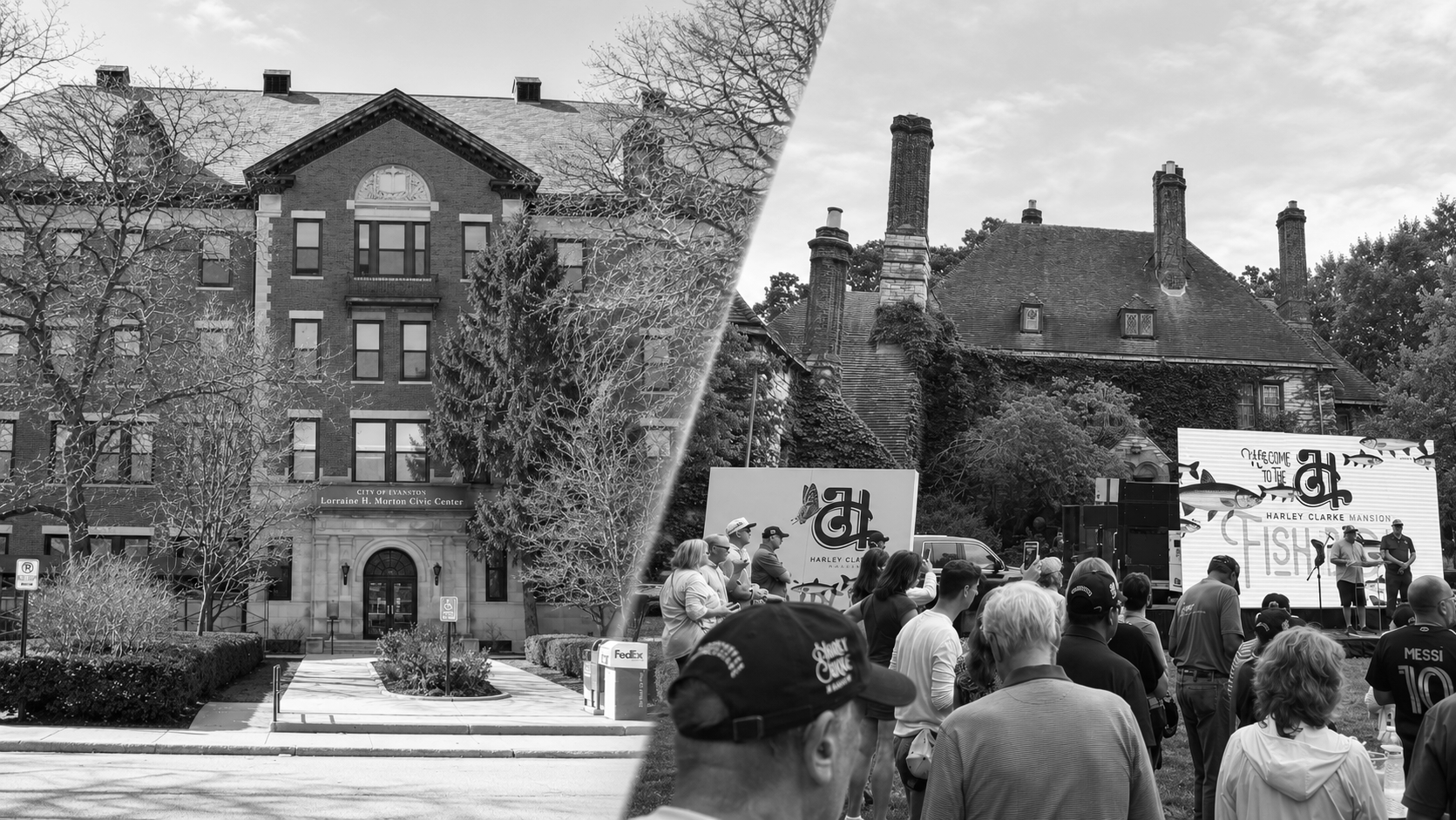
Photo illustration: Evanston Action Coalition; Civic Center photo by Zol87/Wikimedia Commons, CC BY-SA 2.0; Harley Clarke event photo via Friends of Harley Clarke/Facebook.
The City publicly released a heavily redacted version of Celadon’s Harley Clarke proposal. The unredacted records show that some of what disappeared was highly substantive — including material concerning Evanston’s Civic Center. A comparison of different copies also shows that the redactions changed, and the record of who inside the City government actually saw the complete proposal is now itself disputed.
Evanston Action Coalition reviewed an earlier redacted copy obtained by Evanston resident Margaret “Meg” Welch, the later version disclosed by the City and a substantially unredacted copy. EAC also reviewed three comparison JPGs preserved with the earlier source materials. Together, the records reveal a more complicated redaction history than the public record originally suggested — including differences involving references to the Civic Center.
Some financial information may have warranted limited redaction. However, the City also concealed substantive portions of Celadon’s proposal — including details of the alternative development plan examined in Part One of this series, which paired Harley Clarke with another major City-owned property: the Lorraine H. Morton Civic Center at 2100 Ridge Avenue.
A comparison of the redacted copies also identified differences involving references to the Civic Center. Those differences, detailed below, reinforce the central problem: the public was being asked to evaluate a proposal for one City-owned property while substantive portions of the bidder’s submission involving another were hidden from view.
What the public could see
Celadon submitted its response to RFP 24-07 on May 28, 2024.
The version later made available to the public identified a section labeled “C-2. Alternative Financing Plan and Development Scope.” (pp. 191–199) However, substantive portions of that alternative and its supporting financial materials appeared inside redacted sections of the document.
What Evanston residents instead heard publicly was principally Celadon’s primary proposal: an approximately $29.3 million adaptive reuse of Harley Clarke built around an event venue, boutique hotel, restaurant, retail uses, preservation financing and continued public access. That was a real part of Celadon’s submission, but it was not the entire submission.
As Part One documented, C-2 was a separately modeled development program proposing to combine Harley Clarke and the Civic Center as a single 110-unit low-income housing transaction: 100 apartments at 2100 Ridge and 10 studio units at Harley Clarke. Celadon said the alternative was feasible only if the properties were paired.
The supporting material was substantial. The financial model identified the project as “Evanston Civic Center and Harley Clarke,” (pp. 192–193) modeled approximately $74.85 million in sources and uses, and was supported by project-specific work from National Equity Fund and AECOM.
Yet, when the City Council considered Celadon on October 14, 2024, the official decision record presented the proposal as a projected $29,293,010 investment in the adaptive use and rehabilitation of Harley Clarke at 2603 Sheridan Road. Council voted 6-0 among the six members present to authorize the City Manager to negotiate a lease with Celadon.
Contemporaneous public discussion similarly focused on the hotel-and-event redevelopment. The combined Civic Center alternative was not presented in comparable fashion.
The central question is not whether some financial figures were blacked out. It is whether the public record disclosed that Celadon had developed and financially modeled a second alternative whose physical scale and financing depended on bringing the Civic Center into the same transaction. It did not.
Underneath the redactions
The concealed C-2 material went well beyond narrowly sensitive information that may legitimately require redaction, such as private identifying information or competitively sensitive financial details. It obscured the Civic Center itself, the proposed combination of the two properties, the scale and structure of the alternative plan, financial models for the combined project and supporting documentation.
The records showed that the Civic Center was not incidental to C-2. More than 90 percent of its proposed units would have been located there, and Celadon represented that pairing the properties was necessary to make the alternative financially feasible.
The significance of the redactions is heightened by how developed the withheld alternative already was. Before Celadon submitted that response, National Equity Fund was analyzing a specifically identified combined “Evanston Civic Center and Harley Mansion” project, and AECOM had prepared project-specific cost estimates for converting the Civic Center to approximately 100 residential units. The redacted material therefore did not concern a passing or undeveloped suggestion. It concerned a separately modeled development program involving another major City-owned property.
Legitimate protection of genuinely sensitive information does not require withholding an entire substantive development concept. In a later FOIA request seeking the financial records, EAC expressly agreed that account numbers, access codes, Social Security numbers and other narrowly defined private identifiers could remain redacted while requesting the reasonably segregable nonexempt material.
The dispute is not whether every number in every financial spreadsheet should automatically have been public. It is why redactions ostensibly protecting financial or confidential information obscured what property Celadon was proposing to develop, what the alternative consisted of, and how another City-owned asset fit into the proposal.
The redactions changed
Using the earlier redacted version of the same 259-page Celadon submission, EAC conducted a page-by-page comparison with the later City copy. The documents were almost identical, with one consequential difference: the City version contained exactly three additional redactions, all removing text that identified the Evanston Civic Center from Celadon’s combined Harley Clarke–Civic Center financial materials. No other additional City-only redactions were identified across the remaining 256 pages.
The side-by-side comparison makes each change visible. On page 192, the earlier copy leaves “Evanston Civic Center and Harley Clarke” visible in the Sources & Uses title while the City copy masks it; page 193 shows the same change in the Pro Forma NOI title; and page 194 leaves “Evanston Civic Center, Evanston, IL” visible in the AECOM estimate while the City copy masks the location.
The comparison does not establish who made the changes or why. It does establish that the three additional City redactions all obscured Civic Center identifiers that remained visible in the earlier copy.
For an investigation involving whether the public knew Celadon’s Harley Clarke proposal already incorporated 2100 Ridge, that difference is significant.
Welch challenged the redactions before the final lease vote
The redactions were already part of the public record when the City Council first acted on Celadon’s proposal. The City released a redacted version of the RFP response during the selection process in September 2024. On October 14, 2024, Council voted 6-0 among the six members present to authorize the City Manager to negotiate a lease with Celadon.
The records EAC has reviewed do not establish that she had identified the significance of the redactions before that October vote. Her documented challenge came several months later.
On February 13, 2025, Welch filed a FOIA request specifically pointing to the redacted Celadon proposal linked from the October 14 Council packet. She noted that Council had already considered and voted on the proposal and asked the City to provide an unredacted copy.
The City responded on March 3, 2025, but the production remained heavily redacted. The City cited FOIA section 7(1)(b), describing the redactions as private information such as home addresses, telephone numbers, personal email addresses, driver’s license numbers, Social Security numbers and credit card numbers. Yet, entire pages remained redacted.
Three days later, on March 6, 2025, Loevy & Loevy prepared a complaint on her behalf alleging that the City had improperly withheld non-exempt portions of the RFP response. The complaint specifically pointed to the disconnect between the City’s stated explanation and the extent of the redactions.
By then, Council had already authorized negotiations with Celadon but had not yet approved the long-term lease. Her challenge arose between those two Council actions.
According to her later account, she provided the complaint to Evanston RoundTable reporter Duncan Agnew and, that same day, the City informed her that it would unredact the document. She said she received the City’s notice while waiting to make public comment at the March 10, 2025 Council meeting.
The records establish that the complaint existed and was dated March 6; they do not establish that it caused the City to change its position.
The available record also does not establish precisely when she first understood that the material behind the redactions included Celadon’s Civic Center alternative. An earlier redacted copy she later provided to EAC retained several Civic Center identifiers that disappeared from a later City redacted copy. The substantially unredacted copy subsequently revealed the full scope of C-2.
The completeness of Celadon’s proposal had become an active public-record dispute before Council took its final action on the lease.
By the time Council acted on the final agreement, a resident was standing before the Council expressly challenging the redactions, legal counsel had become involved, and the City was being pressed to explain information it had withheld from public view. That prompted an exchange whose significance is clearer in light of the unredacted records.
Corporation Counsel said the unredacted proposal had been provided to Council
During the March 10, 2025 City Council discussion, Corporation Counsel Alexandra Ruggie said that an unredacted version of Celadon’s proposal had previously been provided to Council. She said she believed that occurred in September or October and indicated that she had spoken with Councilmembers who had questions about it.
Then-Councilmember Devon Reid argued immediately beforehand that Councilmember Clare Kelly was conflating different public-record disputes involving Harley Clarke and the Civic Center. However, the assertion that Council had received the unredacted Celadon proposal came from Corporation Counsel Alexandra Ruggie, not Reid.
A contemporaneous email obtained by EAC makes her account more specific.
At 4:16 p.m. on March 10, Ruggie emailed Councilmember Tom Suffredin and directed him to the redacted material beginning around page 191 of Celadon’s proposal.
She wrote:
“These pages were redacted to the public in the City Council packet as it was not an alternative the City was considering.”
Ruggie then said that the unredacted version had been provided to City Council through a Box link.
The email shows that Corporation Counsel was representing concurrently that Council had been given access to a version of Celadon’s proposal that the public did not receive. Her stated explanation for this substantial block of redactions was that the City was not considering C-2 — not that the pages consisted only of account numbers, personal identifiers or isolated confidential financial information.
City staff’s decision not to pursue part of a bidder’s submission may explain how staff evaluated the proposal. It does not explain why residents could not see what the bidder had submitted.
The City would not ordinarily be expected to rewrite Celadon’s proposal simply because staff regarded a portion of it as unsolicited, outside the scope of the RFP or not under consideration. Celadon’s submission is itself a record of what Celadon proposed. Preserving that submission is different from redacting substantive portions from the public version, and Ruggie’s explanation does not identify the legal basis for withholding pages that described a materially different development concept involving another major City-owned property.
RFP 24-07 sought proposals for the adaptive use and rehabilitation of Harley Clarke. Yet, Celadon’s C-2 alternative depended on 2100 Ridge, where 100 of the 110 proposed low-income housing units would have been located.
What Council actually received remains unclear
If an unredacted copy was distributed to Council through a separate Box link in September 2024, Councilmembers potentially had access to information that did not appear in the public packet. However, the accounts EAC has since obtained from Councilmembers do not produce a clean answer about what happened.
Councilmember Clare Kelly, responding to two direct questions, said she did not receive or have access to a version of Celadon’s proposal beyond the redacted public-packet copy and did not know before the October 14, 2024 vote that Celadon’s response contained the C-2 Civic Center alternative.
Councilmember Jonathan Nieuwsma remembers the situation differently. Going by memory while away from his files, Nieuwsma told EAC that he recalled Council being aware Celadon had included a proposal involving 2100 Ridge, but remembered that portion of the document itself being redacted from what Council received because it was unsolicited and outside the scope of the RFP.
“I believe what Council saw is the same as the publicly available document,” Nieuwsma wrote.
Councilmember Tom Suffredin provided evidence supporting Ruggie’s account. After EAC asked him about the issue, Suffredin forwarded Ruggie’s March 10, 2025 email and said he believes Council received the referenced Box link in September 2024.
However, he added: “I can’t find that email.”
Kelly remembers neither receiving an unredacted proposal nor knowing about C-2 before the October vote. Nieuwsma remembers Council knowing that an out-of-scope 2100 Ridge proposal existed but believes Council saw the same redacted document available publicly. Suffredin believes a separate Box link was distributed, consistent with Ruggie’s later account, but has been unable to locate the original transmission.
EAC has filed a FOIA request seeking that underlying record. The transmission could establish when an unredacted proposal was made available, who received it and what version it contained. It is unlikely to establish who opened the document, reviewed C-2 or understood its significance before voting. Whatever that record ultimately shows, it does not change an established fact: the public did not receive the substantive information contained in the unredacted proposal.
In 2026, the City gave a different reason for withholding the underlying financial records
In July 2026, EAC separately sought the financial records underlying Celadon’s May 2024 submission.
FOIA Request 26-3154 sought Celadon’s Sources and Uses, Pro Forma, Assumptions, Operating Expenses and Development Budget; original spreadsheet versions maintained by the City; subsequent revised or replacement versions; and related Lakeside Bank and National Equity Fund financing records.
EAC expressly told the City that account numbers, access codes, Social Security numbers and other narrowly defined private identifiers could remain redacted. The request also specifically asked the City to produce all reasonably segregable nonexempt portions.
The City nevertheless denied the request “in its entirety,” citing section 7(1)(g) of the Illinois Freedom of Information Act, the exemption covering qualifying trade secrets and commercial or financial information.
The denial then attributed the substantive explanation directly to City Planner Cade Sterling:
“The information contains trade secrets the release of which would be detrimental to the submitting parties ability to compete with other similar organizations.”
Sterling continued:
“Each respondent was given the opportunity to redact sensitive financial information as part of the RFP process.”
And he explained why, in his view, disclosure through FOIA would be problematic:
“Being able to simply FOIA that unredacted information afterward would seem to undermine that and impact future transparency by submitting parties and the City's ability to assess financial viability of proposals.”
The City was not merely asserting that isolated figures or particular financing terms were confidential. Sterling argued that permitting a requester to obtain the unredacted information through FOIA could undermine the confidentiality afforded to RFP respondents and potentially affect what developers disclose to the City in future procurements.
However, the denial did not identify which particular figures, assumptions, formulas, financing terms or other information would cause the asserted competitive harm if disclosed. Despite EAC’s explicit request for segregable records and its agreement that genuinely private information could remain protected, the City withheld the requested records in their entirety.
EAC challenged that blanket denial before the Illinois Attorney General’s Public Access Bureau, where the review remains pending as PAC 96310.
On August 28, 2026, Assistant Attorney General Bradley Snyder notified City Clerk and FOIA Officer Stephanie Mendoza that the Public Access Bureau had determined that “further action is warranted.”
The Attorney General’s office directed the City to provide the withheld records for confidential review and to give a detailed factual and legal explanation supporting its reliance on section 7(1)(g).
The Public Access Bureau also directed the City to address whether its position complies with binding Public Access Opinion 18-004, which involved a municipality’s attempt to withhold a redevelopment budget prepared by an outside developer.
Among other things, the Bureau asked the City to substantiate that the submitting entity actually faces competition and that disclosure would likely cause substantial competitive harm. It also instructed the City to address whether responsive records could instead be released with legitimately exempt portions redacted.
The Public Access Bureau has not found a FOIA violation; its review remains pending. Nonetheless, the contrast in the record is significant.
The two episodes arose in different circumstances, but the City relied on materially different explanations. In March 2025, Ruggie said the material had been withheld from the public packet because the City was not considering that alternative. In July 2026, when EAC sought the underlying financial records themselves and expressly allowed genuinely protected material to remain redacted, the City instead invoked trade secrets and competitive harm and withheld the requested records in their entirety.
That second withholding is now under active review by the Illinois Attorney General’s Public Access Bureau.
What remains unanswered
The documentary record now establishes two things separately: Celadon submitted a developed alternative pairing Harley Clarke with the Civic Center, and the version made available to the public concealed substantive portions of that alternative. What remains unresolved is who inside the City government saw the complete proposal and what they understood about it before Council acted.
One potentially important record is still outstanding: the Box-link transmission referenced by Corporation Counsel Alexandra Ruggie. EAC has filed a FOIA request seeking it, but it has not yet been produced.
That transmission could establish when an unredacted version of Celadon’s proposal was made available, who received it and which version was distributed. It cannot establish who actually opened the document, reviewed C-2 or understood its significance. Nor would it establish whether Councilmembers were ever substantively briefed on Celadon’s alternative involving 2100 Ridge.
Those questions matter because the public record available during the Harley Clarke proceedings did not reveal the proposal in comparable detail. Celadon had modeled a 110-unit low-income housing alternative pairing the two City-owned properties, with 100 units proposed for the Civic Center, yet substantive portions of that plan and its supporting materials remained outside public view.
The remaining questions therefore go beyond whether a Box link was sent: Who actually reviewed the unredacted material? Was the Civic Center alternative affirmatively discussed with Councilmembers? Why was substantive information about it withheld from the public? And why did a developed proposal involving another major City-owned property never become part of the public discussion surrounding Harley Clarke?
Related coverage
Sept. 27, 2024 — Chicago Sun-Times: Developer’s plan would usher commercial uses into Evanston’s landmark Harley Clarke Mansion
Pre-Council coverage of Celadon’s proposal, describing a roughly $29 million rehabilitation of Harley Clarke as an event and dining space, boutique hotel and retail use. The story reported that City staff had rated Celadon highest among three bidders and would recommend the proposal to Council.
Oct. 15, 2024 — The Daily Northwestern: City to negotiate a lease to rehabilitate Harley Clarke Mansion
Coverage of Council’s 6-0 authorization to begin lease negotiations with Celadon. The article described the proposal presented publicly as a roughly $29 million renovation creating 10 hotel rooms and a wedding and event venue, while also reporting resident concerns about public access and the limited opportunity for public discussion before the vote.
Oct. 17, 2024 — Evanston RoundTable: How Celadon won City Council vote for Harley Clarke lease
Follow-up coverage of Celadon’s selection and Council’s decision to move into lease negotiations, including the competing proposals for Harley Clarke and the debate surrounding the City’s selection process.
Feb. 26, 2025 — The Daily Northwestern: City Council delays decision on Harley Clarke Mansion
Coverage of Council’s decision to postpone final action on the proposed Celadon lease until March 10, with discussion focused principally on the terms of the lease, continued public access to the property and concerns involving the Lighthouse Beach fire pit.
Mar. 9, 2025 — Evanston RoundTable: City Council notes: Federal funding, Civic Center future and more on tonight’s agenda
Preview of the March 10 Council meeting identifying the proposed 40-year Celadon lease as the second phase of approval for the Harley Clarke rehabilitation project following Celadon’s selection the previous October.
Mar. 11, 2025 — Evanston RoundTable: Council approves lease to create an event venue at Harley Clarke
Coverage of Council’s final approval of the long-term lease with Celadon following the March 10 meeting.
Resources
Celadon Construction Corporation NFP — RFP 24-07 Response, Unredacted Version
Celadon’s May 28, 2024 submission. C-2, “Alternative Financing Plan and Development Scope,” appears at pp. 191–199, including the combined Harley Clarke–Civic Center Sources & Uses at p. 192, Pro Forma NOI at p. 193 and supporting AECOM material beginning at p. 194.
City of Evanston via Margaret “Meg” Welch — Earlier Redacted Copy of Celadon RFP 24-07
The earlier 259-page redacted version obtained by Welch. Comparing this copy with the later City-disclosed version shows that Civic Center identifiers remained visible on three pages that were subsequently redacted in the City copy.
City of Evanston — Celadon RFP 24-07 Redacted Public Version
The later City version used in EAC’s page-by-page comparison. It contains three additional redactions on pp. 192–194 obscuring references to the Evanston Civic Center that remained visible in Welch’s earlier copy.
EAC Forensic Comparison — Celadon Financial Materials, pp. 190–195
Side-by-side comparison of the Welch and City copies showing the three additional City redactions affecting the Sources & Uses title, Pro Forma NOI title and AECOM Civic Center location.
EAC Forensic Comparison — Redacted Pages in Welch Copy
Montage of the pages carrying redactions in the earlier Welch version, preserved as part of EAC’s comparison record.
Welch v. City of Evanston — Draft FOIA Complaint
The March 2025 complaint prepared by Loevy & Loevy challenging the City’s redactions of Celadon’s RFP response and arguing that nonexempt portions of the proposal had been improperly withheld.
City of Evanston FOIA 25-495 — Welch Celadon RFP Correspondence
Records concerning Welch’s request for an unredacted Celadon proposal and the City’s March 2025 handling of that request immediately before the Council’s final lease vote.