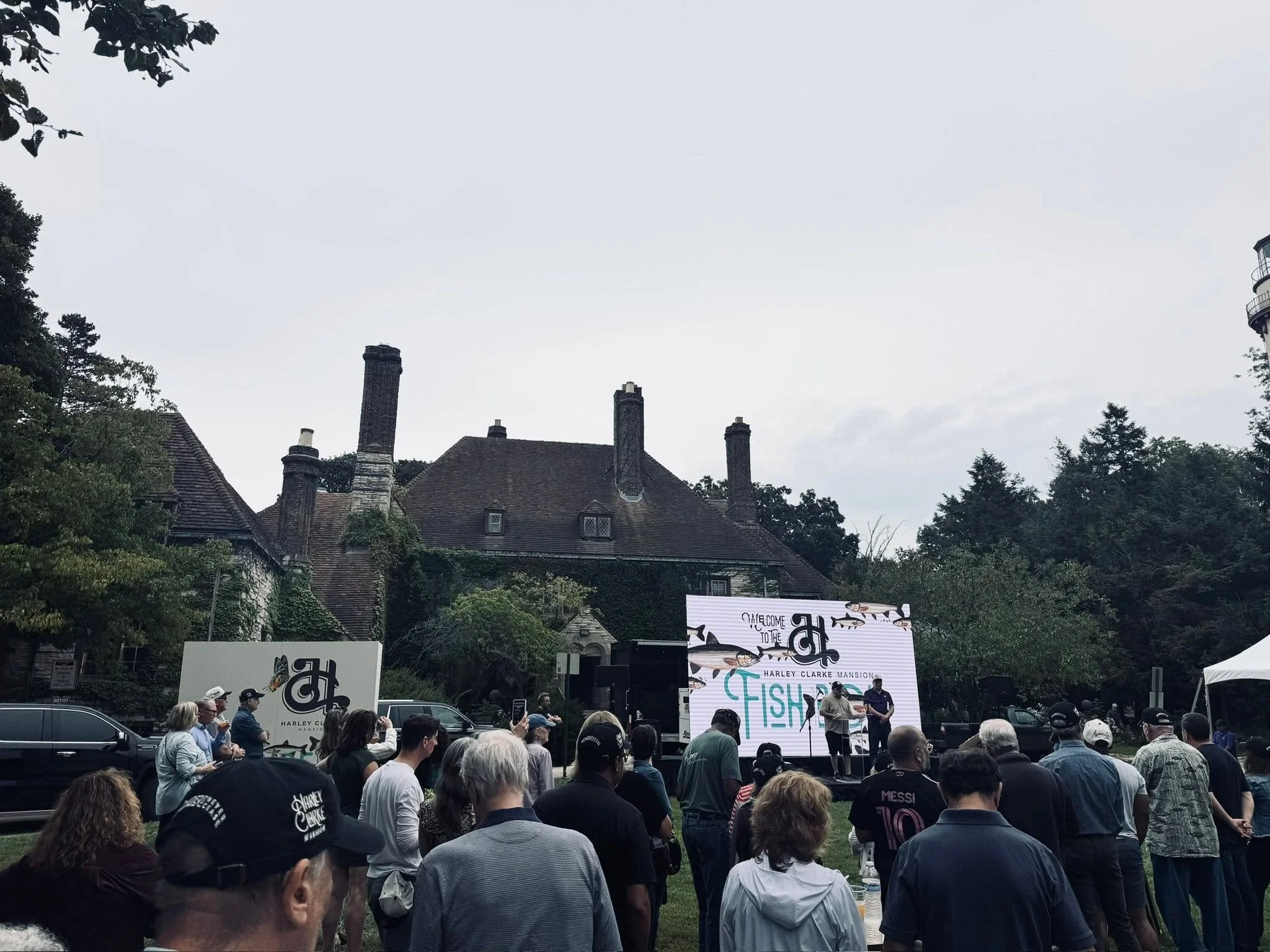
Celadon’s Scott Henry addresses the Community Fish Boil on Saturday, September 20, 2025. Source: Friends of Harley Clarke Facebook page. Used for reporting and commentary.
Celadon’s May 28, 2024 response to Evanston’s Harley Clarke RFP contained more than the $29.3 million hotel-and-event redevelopment later presented publicly. It also contained a separately modeled 110-unit low-income housing alternative that would have combined Harley Clarke with Evanston’s Civic Center at 2100 Ridge Avenue in a single transaction.
In the spring of 2024, the City of Evanston sought proposals for a very specific piece of public property: the Harley Clarke Mansion and its grounds at 2603 Sheridan Road.
The City described RFP 24-07 as a solicitation for the “adaptive use and rehabilitation” of Harley Clarke and set May 28, 2024, as the deadline for responses.
Celadon Construction Corporation NFP submitted its response on May 28, 2024.
What Evanstonians later heard about that proposal was largely straightforward: Celadon proposed an approximately $29 million restoration of Harley Clarke built around an event venue, boutique hotel, restaurant and retail uses, while maintaining public access and working with Jens Jensen Gardens in Evanston on the grounds and coach house.
That description was accurate — but incomplete.
The full May 28, 2024 response contained two substantially different development paths. The first was the familiar $29.3 million Harley Clarke redevelopment. The second appeared under a section labeled “C-2. Alternative Financing Plan and Development Scope.” Although that heading remained visible in the public version, substantive portions of the C-2 plan and its supporting materials were redacted. In the fuller response, C-2 proposed combining Harley Clarke with the Lorraine H. Morton Civic Center at 2100 Ridge Avenue “under a single transaction” as an affordable-housing project.
The primary plan: a $29.3 million mixed-use Harley Clarke redevelopment
Celadon’s primary proposal envisioned restoring the mansion as a combination of wedding and event space, hotel, restaurant, retail and public community space. Celadon represented the total development cost as $29,293,010. That figure later became the investment amount cited by City staff when recommending that the City Council begin lease negotiations.
Celadon proposed leasing the mansion, coach house and grounds from the City for 99 years at $1 per year. It also proposed subleasing the grounds and coach house to Jens Jensen Gardens in Evanston for $1 per year, providing the organization with $3.2 million for work on the gardens and coach house and as much as $230,000 annually for ongoing operations.
Those were Celadon’s May 28, 2024 proposal terms, not the terms ultimately executed. The lease approved by the City Council on March 10, 2025, did not adopt Celadon’s proposed 99-year term. Instead, it established a 40-year initial term, from March 1, 2025 through March 1, 2065, with successive five-year renewal periods. The nominal $1 annual rent, however, remained part of the final agreement.
Celadon also proposed adding ten parking spaces reserved for hotel guests and using off-site parking and electric shuttles for other visitors. The proposal emphasized that much of the mansion's ground floor and grounds could remain available for public activity when private events were not taking place.
The hotel was not a minor feature of the plan Evanston selected. The March 2025 lease expressly contemplated a boutique hotel of approximately 10 rooms, not to exceed 15, and the hotel remained part of Celadon’s publicly described redevelopment into the fall of 2025.
By May 27, 2026, however, the project Celadon was advancing no longer included the hotel component. In the City’s zoning analysis, the proposed adaptive reuse was described as an event space, Type 1 restaurant, take-out ice-cream and coffee shop and small retail store. No hotel was included. Subsequent 2026 City records likewise describe an event-venue project rather than a hotel, and Celadon’s current Harley Clarke website presents the future property as a community gathering place and event venue with restaurant, ice cream, retail and event uses — not lodging.
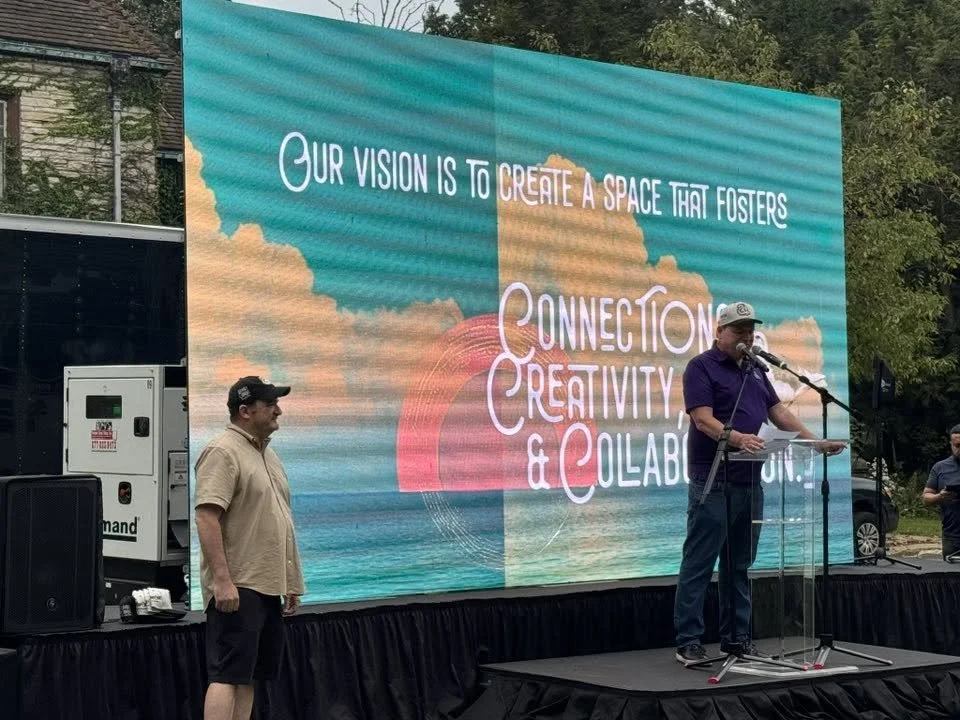
At the September 20, 2025 Community Fish Boil at Harley Clarke, a presentation described the project’s vision as a space fostering “Connection, Creativity & Collaboration.” Source: Friends of Harley Clarke Facebook page. Used for reporting and commentary.
The change is financially significant because the hotel was built directly into the economics of Celadon’s May 2024 proposal. Celadon’s pro forma projected $15.552 million in annual operating revenue: $10.8 million from weddings, $2.352 million from the hotel, $1.92 million from the restaurant and $480,000 from other events. The hotel represented 15.1% of projected operating revenue; after Celadon’s modeled 25% hotel-vacancy assumption, it still represented approximately $1.764 million in effective annual revenue. Weddings alone accounted for 69.4% of the projected total. After modeled hotel and commercial vacancy, the pro forma projected approximately $15.05 million in effective gross income and about $2.54 million in net operating income.
The public record reviewed for this investigation does not identify when the hotel ceased to be part of the project Celadon was advancing, why the project changed, or how the loss of that projected revenue affected the financing and operating assumptions underlying the $29.3 million proposal. The executed lease still lists a boutique hotel among its permitted uses. However, the redevelopment Celadon was advancing through the City’s approval process in 2026 no longer included one.
The scale of that wedding-revenue assumption becomes clearer when compared with Celadon’s own description of the venue. Elsewhere in the same RFP, Celadon described a wedding venue operating one to two days per week, with capacity for up to 170 people per event. If that stated frequency were maintained across a 52-week year, Celadon’s $10.8 million annual wedding-revenue projection would require approximately $104,000 to $208,000 in gross revenue per wedding day, assuming one wedding event per wedding day. At the stated maximum capacity of 170 guests, that would equate to approximately $611 to $1,222 in gross wedding revenue per attendee. These figures are calculations based on Celadon’s own revenue, frequency and capacity assumptions; they are not figures separately stated by Celadon.
Taken together, those changes raise a basic question about the durability of the financial assumptions underlying the proposal Evanston selected. Celadon presented the City with a $29.3 million redevelopment whose operating model depended heavily on wedding revenue and included $2.352 million annually from a boutique hotel. That hotel was later omitted from the project Celadon advanced, yet the public record reviewed for this investigation does not show a revised operating pro forma explaining how the lost revenue would be replaced or whether the original financial assumptions still held. The project being advanced in 2026 was therefore materially different from the specific hotel-and-event redevelopment on which Celadon’s original financial model was based.
Celadon itself acknowledged the primary plan’s dependence on this activity when introducing its alternative, describing a “strong reliance” on weddings and other revenue-producing uses that would produce intensive use of the property at certain times.
Celadon presented the C-2 alternative as a way to reduce that reliance on intensive private-event revenue.
C-2: a second development path dependent on 2100 Ridge
Celadon submitted C-2 only weeks after the Civic Center entered Evanston’s broader Putting Assets to Work strategy. The City Council adopted the PAW plan on April 29, 2024 — 16 days before National Equity Fund’s May 15 financing analysis and 29 days before Celadon’s May 28 RFP response. The City’s later PAW implementation solicitation would identify the Lorraine H. Morton Civic Center at 2100 Ridge Avenue as one of three major City-owned assets to be evaluated for redevelopment or repurposing.
Celadon told the City that if Evanston preferred a less intensive use of Harley Clarke, it had another option: combine Harley Clarke and the Civic Center “under a single transaction” as an affordable-housing project.
This was not simply another way to finance the same Harley Clarke proposal. It was a 110-unit development program centered overwhelmingly on a second City-owned property that was not the subject of RFP 24-07.
Of the 110 proposed apartments, 100 — more than 90% — would have been located in the Civic Center at 2100 Ridge Avenue. Only 10 studio apartments would have been constructed inside Harley Clarke, on the second floor and part of the third floor. The remainder of the mansion, Celadon said, would instead be used for community events, job training and classes, reducing its reliance on weddings and other private-event revenue.
The role of 2100 Ridge went beyond supplying most of the housing units. Celadon expressly stated that the alternative was “only feasible” if Harley Clarke and the Civic Center, the historic Marywood Academy, were paired together. Harley Clarke alone, Celadon said, was too small as an affordable-housing project to qualify for the additional financing needed to make the redevelopment work.
Taken together, those facts make C-2 more than a secondary financing option for Harley Clarke. More than 90% of the proposed housing would have been located at 2100 Ridge, and Celadon said pairing the two properties was necessary to obtain the financing the alternative required.
This was already a substantially developed project
The C-2 materials went well beyond a narrative description. Celadon wrote that the alternative had been “vetted in as detailed a fashion” as its primary Harley Clarke financial plan. The RFP package included a separate C-2 pro forma and sources-and-uses model, a project-specific AECOM construction-cost estimate and a National Equity Fund financing analysis.
The financial model treated Harley Clarke and the Civic Center as a single project identified as “Evanston Civic Center and Harley Clarke.” It totaled $74,850,076 in proposed sources and uses, including approximately $30.7 million in affordable-housing construction costs, nearly $18.9 million in commercial and event construction costs and a modeled $6 million acquisition cost. It also laid out a development schedule: construction beginning in June 2025, ending in June 2026, followed by lease-up through June 2027.
Those figures were Celadon’s development assumptions, not terms accepted by the City of Evanston. The records do not establish that Evanston agreed to a $6 million acquisition price, approved the $74.85 million project, authorized the proposed schedule or accepted the financing structure. They do establish, however, that before Celadon submitted its Harley Clarke response, outside firms were already performing project-specific work on the proposed combined development.
On May 15, 2024 — thirteen days before the RFP deadline — National Equity Fund Vice President Danny Gutman sent Scott Henry of Celadon a letter concerning a project expressly identified as “Evanston Civic Center and Harley Mansion.” NEF described it as the adaptive reuse of the two properties into a 110-unit low-income housing project.
NEF's analysis contemplated approximately $27.99 million in Low-Income Housing Tax Credit equity, together with federal and Illinois historic-tax-credit equity. The letter stated that its terms were based on information NEF had received and on assumptions made by NEF regarding the project's development budget, lease-up schedule, operating pro forma and ownership structure.
By May 15, therefore, NEF had already received substantive project information and had developed assumptions concerning the combined project's budget, operations, lease-up and ownership structure.
Celadon characterized the NEF material in its RFP narrative as reflecting “commitments by NEF.” NEF's letter itself was more limited: it was preliminary, its terms were subject to change, and NEF stated that a binding letter of intent would be issued only after the project received a Low-Income Housing Tax Credit award.
The May 15 letter was not final financing. It does, however, document that nearly two weeks before Celadon submitted its response to the Harley Clarke RFP, an outside financial institution was already evaluating a specifically identified 110-unit project combining Harley Clarke with 2100 Ridge Avenue.
The PAW implementation process came later
The City did not begin soliciting professional services to implement Putting Assets to Work until December 2024, months after Celadon submitted C-2 and after the related NEF and AECOM work. After receiving five proposals, staff recommended Propviser on February 24, 2025, and the City executed a professional-services agreement on March 6, 2025. The timing separates that later consultant-led implementation process from the combined Harley Clarke–Civic Center proposal Celadon had already prepared and submitted in May 2024.
What the public discussion focused on
When Evanston publicly released the competing Harley Clarke proposals in September 2024, and when the City Council considered Celadon on October 14, 2024, the publicly described project was the primary Harley Clarke redevelopment. The October 14 agenda framed the decision as whether to authorize negotiations with Celadon for a projected $29,293,010 private investment in the adaptive use and rehabilitation of 2603 Sheridan Road; Council approved that authorization 6-0 among the six members present. Contemporaneous descriptions likewise emphasized the boutique hotel, event venue, restaurant, retail, preservation financing and public-access components.
Those descriptions accurately reflected Celadon’s primary plan. However, the fuller RFP shows that it was only one of two materially different development paths Celadon submitted. The City’s publicly available proposal identified a C-2 “Alternative Financing Plan and Development Scope,” but the substantive combined-property plan and supporting financial materials were redacted and were not available in the same form as they appear in the fuller proposal reviewed for this investigation.
What the records now show
Celadon’s May 28, 2024 submission was not simply a $29.3 million proposal to restore Harley Clarke as a hotel, restaurant and event venue. It contained two materially different development paths.
The second was a substantially developed $74.85 million low-income housing proposal that depended on combining Harley Clarke with another major City-owned property, the Civic Center at 2100 Ridge Avenue. More than 90% of its proposed housing would have been located at 2100 Ridge, and Celadon expressly stated that the alternative was feasible only if the two properties were paired. Before the Harley Clarke RFP deadline, National Equity Fund and AECOM were already performing project-specific financing and cost analysis on that combined development.
That is materially different from the Harley Clarke redevelopment that dominated the public discussion when Celadon was selected in October 2024. It also matters because the primary proposal itself later changed: the boutique hotel that supplied $2.352 million of Celadon’s projected annual revenue was no longer included in the project being advanced by May 2026.
The documents therefore establish something narrower, but significant: Celadon’s submission was considerably broader than the familiar Harley Clarke hotel-and-event proposal presented publicly.
What remains unresolved is who could see that broader submission at the time. The public version was redacted. Councilmember Clare Kelly has since stated that she did not know C-2 was included when she voted to authorize negotiations with Celadon. Councilmember Jonathan Nieuwsma, while expressly relying on memory, separately recalled that Council knew Celadon had included a proposal for 2100 Ridge, but that the 2100 Ridge portion was redacted from what Council was provided and that Council saw the same version as the public. That recollection is difficult to reconcile with Corporation Counsel Alex Ruggie’s later statement in open session that an unredacted version had been released to the Council and discussed with several Councilmembers. Councilmember Tom Suffredin has since told EAC that he believes Council received the referenced Box link in September 2024, but he could not locate the email containing it. Kelly, meanwhile, has said she did not know of C-2 before the vote and recalled that then-City Manager Luke Stowe initially dismissed Celadon/2100 Ridge talk as rumor when she asked about it afterward.
That is where the next installment begins: what was redacted, how those redactions changed, what Councilmembers actually received, and how those conflicting accounts fit the documentary record.
Update, Sept. 3, 2026: This article was updated to include conflicting Council recollections. Jonathan Nieuwsma recalled that Council knew Celadon had proposed 2100 Ridge but saw the same redacted version as the public. Tom Suffredin recalled that Council received an unredacted Box link in September 2024, but said he could not locate the email containing it. Clare Kelly has said she did not know of C-2 before the Oct. 14 vote and recalled that, afterward, City Manager Luke Stowe initially dismissed Celadon/2100 Ridge talk as rumor. The discrepancy remains unresolved.
Related Coverage
Sep. 27, 2024 — Chicago Sun-Times: Developer’s plan would usher commercial uses into Evanston’s landmark Harley Clarke Mansion
Contemporaneous reporting on Celadon’s publicly presented Harley Clarke proposal, describing an approximately $29 million redevelopment centered on an event venue, restaurant and small hotel while preserving public ownership of the property.
Oct. 15, 2024 — The Real Deal: Celadon wins bid to develop hotel at historic Harley Clarke mansion
Real estate industry coverage of the City Council’s selection of Celadon for lease negotiations, describing the proposal as a $29 million adaptive reuse with a 10-room boutique hotel, restaurant, ice cream parlor, event space and other commercial uses.
Oct. 17, 2024 — Patch: $29 Million Plan To Turn Harley Clarke Mansion Into Hotel, Bar, Restaurant Space Approved
Detailed local coverage following the October 14, 2024 City Council vote, describing Celadon’s proposal as a $29 million restoration built around a boutique hotel, restaurant, bar and event venue, with continued public access and an anticipated 99-year lease.
Oct. 17, 2024 — Chicago Tribune: Evanston’s Harley Clarke mansion set to become wedding venue, hotel, speakeasy, ice cream parlor
Coverage of the City Council’s decision to enter lease negotiations with Celadon, emphasizing the approximately $29.2 million investment, 10 hotel rooms, wedding venue, speakeasy, ice cream parlor and Jens Jensen Gardens partnership.
Aug. 30, 2026 — Evanston RoundTable: Here in Evanston: Building change
Later coverage of the Putting Assets to Work process at 2100 Ridge Avenue, identifying Celadon as a leading proponent of an affordable assisted-living redevelopment and noting Celadon’s existing role in the Harley Clarke redevelopment.
Resources
City of Evanston — RFP 24-07: Adaptive Use and Rehabilitation of Harley Clarke Mansion and Grounds
The City solicitation to which Celadon responded, defining the subject property as the Harley Clarke Mansion and Grounds at 2603 Sheridan Road and establishing the scope of the redevelopment request.
Celadon Construction Corporation NFP — RFP 24-07 Response
Celadon’s fuller submission, containing the approximately $29.3 million hotel-and-event redevelopment as well as the separately developed C-2 alternative combining Harley Clarke with the Civic Center, together with the proposal’s financial models and supporting analyses.
City of Evanston FOIA Production 26-3050 — Celadon / Harley Clarke Proposal Records
City-produced records concerning Celadon’s Harley Clarke submission and selection, including the fuller/revised RFP response, supporting attachments, financial materials, and versions containing redactions discussed in this series.
City of Evanston — Celadon RFP 24-07 Redacted Public Version
The version of Celadon’s proposal released publicly during the selection process. It identifies the C-2 “Alternative Financing Plan and Development Scope,” while substantive portions of that alternative and supporting financial materials appear within the redacted sections.
City Council — Harley Clarke RFP 24-07 Agenda and Staff Materials
The official Council materials recommending authorization to negotiate a lease with Celadon based on a projected $29,293,010 private investment in the adaptive use and rehabilitation of 2603 Sheridan Road, together with the meeting record documenting the Council action.
City of Evanston / Celadon Construction Corporation NFP — Executed Harley Clarke Lease
The final lease for 2603 Sheridan Road, establishing the initial lease term and $1 annual rent and listing a boutique hotel of approximately 10 rooms, not to exceed 15, among the permitted uses.
City of Evanston FOIA Production 26-3521 — Harley Clarke Implementation and Project Records
Later City-produced records concerning implementation of the redevelopment, including the executed lease and zoning and project materials documenting the uses being advanced in 2026. Those records help document the project-scope change discussed in this article.